Soccer Culture & Youth Development
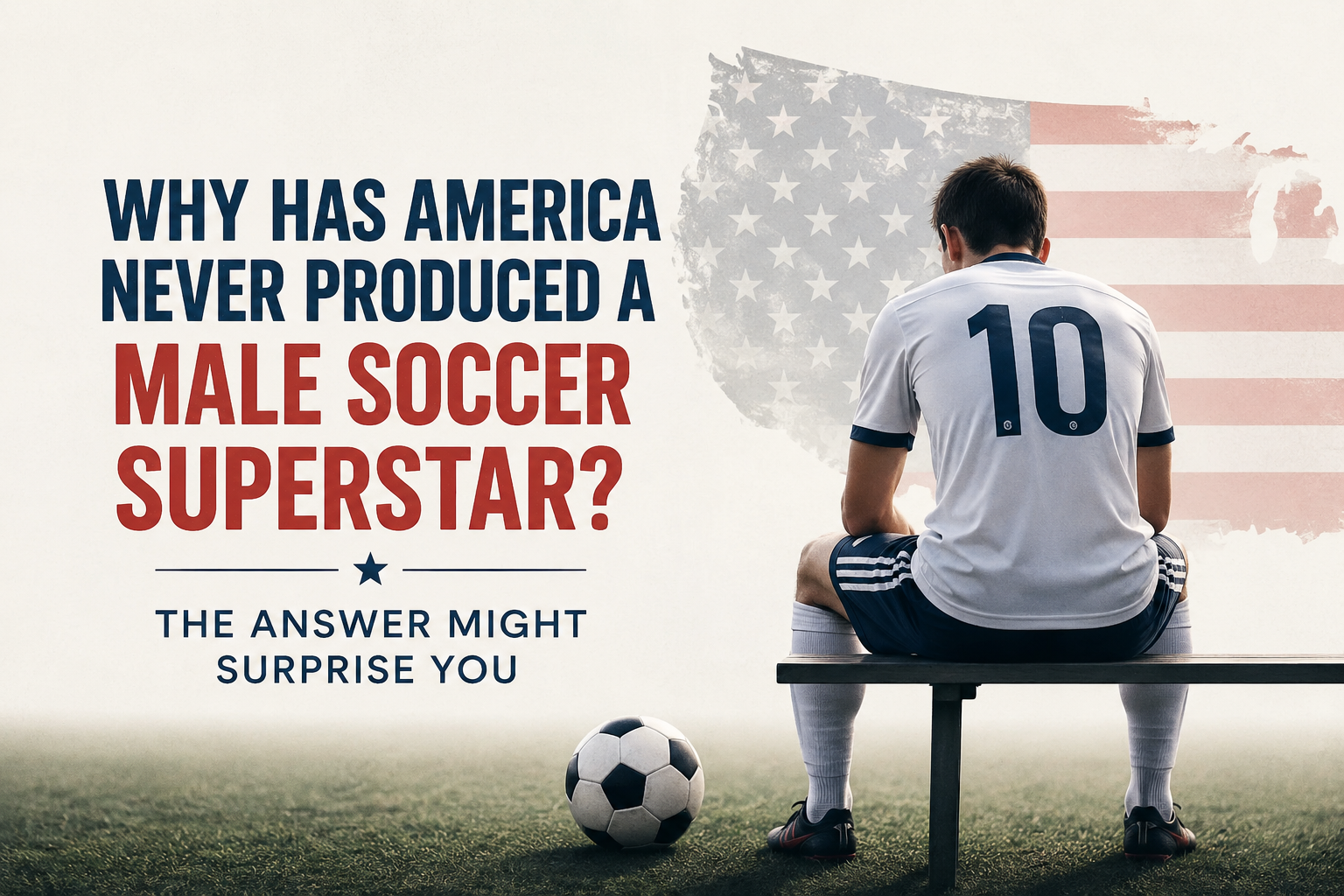
The 2026 World Cup is here. Billions of eyes are on the beautiful game. And the most powerful sporting nation on Earth still can't answer one burning question: why hasn't America produced a single male soccer superstar?
The United States has produced legends in virtually every major sport. Basketball gave us Michael Jordan, LeBron James, Kobe Bryant. Football gave us Tom Brady and Jerry Rice. Baseball, boxing, track and field — name the sport and America has produced transcendent, generational talent.
But soccer? The world's game? The sport played by more humans on this planet than any other? America is still waiting.
Walk through the halls of any major American soccer convention and you'll hear the buzzwords flying. Philosophies. Methodologies. Pathways and pyramids. But strip away the jargon and most serious people in the game will eventually land on the same single word when you ask them why.
The one word every expert keeps coming back to
Culture.
And with the 2026 World Cup being played on American soil, the question has never been more urgent, more relevant, or more fascinating.
In This Article
The Uncomfortable Truth
Let's start with a fact that should stop you cold.
According to the U.S. men's national team's own head coach and virtually every objective ranking system, the United States does not have a single male soccer player in the global top 100 in 2026. Not one.
330 million people.
More resources, more sports infrastructure, more coaching education dollars, and more youth participation than almost any nation on Earth. And yet, when you rank the 100 best male soccer players in the world right now, no American makes the list.
And it's not just bad luck. It's not a fluke.
When you look at where those top 100 players do come from, a staggering pattern emerges. Roughly 80 percent come from just 10 countries — the eight World Cup-winning nations, plus the Netherlands and Portugal.
Luck doesn't explain that pattern. Random chance doesn't explain it. Culture and systems do.
What Messi, Mbappé, and Ronaldo All Have in Common
Before we diagnose the American problem, it's worth understanding what the rest of the world gets right.
Lionel Messi. Cristiano Ronaldo. Kylian Mbappé. Lamine Yamal. These names represent the absolute pinnacle of the sport. And yes, they were all born with extraordinary, once-in-a-generation talent. Nobody is denying that.
But they also share something else. Something less discussed. Something that had nothing to do with their DNA. They were all born into cultures where soccer was inescapable.
Messi grew up in Rosario, Argentina. Mbappé in Bondy, a dense suburb of Paris. In both cities, soccer isn't a sport people choose. It's part of the air they breathe.
Mbappé was toddling through the hallways of the amateur club where his father coached at age 2. When he received a toy truck for his third birthday, he left it in the corner and went looking for a ball. "I just wanted the ball. To me, the ball was everything."
Across France, Spain, Argentina, Brazil, Germany, Portugal, Colombia, Uruguay, and dozens of other countries, there are millions of kids just like him.
Kids who grow up ball-obsessed. Who play in parks and streets and living rooms without being told to. Who develop touch and feel and instinct through sheer accumulated hours before they ever set foot on an organized field.
That's where elite soccer players come from. Not from academies. Not from expensive coaching sessions. From culture.
The American Starting Line
Christian Pulisic is the best American male soccer player of his generation. By a significant margin.
He plays for AC Milan, competes in the Champions League, and is widely considered one of the better players in Serie A. He is also, by global standards, not a superstar. Not top 50 in the world. Possibly not top 100.
Youth development expert Tom Byer helped transform Japanese soccer into a global competitor. His argument about America is straightforward and sobering: soccer is a sport that "unfortunately takes a ridiculous amount of time to become good at."
The ball-handling and technical skills are so complex, so deeply motor-pattern dependent, that they need to be developed in early childhood to reach elite levels.
Byer calls the first six years of a child's life the "golden age" for skill acquisition and ball mastery. In the world's strongest soccer cultures, kids arrive at their first organized team already possessing fundamental technical building blocks — developed through years of free play at home and in their neighborhoods.
The Starting Line Gap
Strong Soccer Cultures
Kids arrive at their first team with fundamental technical skills already built. They're ready to be coached.
America
Most kids join their first team to learn the basics. They arrive without those building blocks.
"So they're already starting at a deficit. In the strong football cultures, the start line is a mile ahead." — Tom Byer
The System That Capitalism Built
In countries where soccer culture runs deep, the game grew organically around community. Local clubs. Neighborhood teams. Street games that turned into youth leagues. The infrastructure built itself around the sport, and the sport stayed accessible because it was embedded in daily life.
In America, soccer arrived late. And in the absence of deep-rooted culture, something else stepped in to fill the void. Capitalism.
The American youth soccer system didn't grow around the needs of children. It grew around economic opportunity.
Around competition between clubs for players and registration fees. Around a landscape where winning — not developing — drives business decisions, because winning builds a club's brand and attracts more paying families.
The result is a youth soccer ecosystem that experts describe as fragmented, expensive, political, and broken.
Exorbitant fees eliminate enormous swaths of the talent pool before they ever get a real look. And a culture within many clubs prioritizes winning youth tournaments over long-term player development — because winning markets the club, and marketing drives revenue.
Crocker tried to create a clear, simple pathway. He pushed for reforms. He ran into resistance at every turn — from clubs and organizations protecting their financial interests.
From the Podcast — The Inside Scoop
The Real Reason Youth Soccer Is So Expensive
PRO/REL, MLS, and why the cost problem is more complicated than blaming any single organization. Neil breaks it all down.
Culture Is a Multiplier
There's one more dimension to this that doesn't get discussed enough: talent concentration.
In any sport, elite players don't develop in isolation. They develop by competing against each other — day after day, year after year, pushing one another to new levels.
This is why the Paris suburbs produce a disproportionate number of the world's top soccer players. Not because of Clairefontaine, the French federation's legendary academy. But because there are so many ball-obsessed kids concentrated in those neighborhoods that they're constantly competing against equally talented peers.
Culture creates talent density. And talent density creates elite players.
In the U.S., that density simply doesn't exist at scale. The pool is smaller. The concentration is thinner.
The kids who do have elite potential aren't being sharpened by their environment the same way a kid in Lyon or Buenos Aires would be.
So What’s the Actual Solution?
The cost of youth soccer in America is too high for too many families. That's real.
It is pricing out talent, limiting access, and creating a system where financial resources are too often confused with athletic potential.
But the solutions have to be grounded in reality — not in fantasies about replicating another country's model wholesale.
Five structural changes could make a meaningful difference:
An Open, Transparent Competitive Pyramid
One of the biggest structural issues is the absence of a clear, open pyramid that allows motivated volunteers and smaller organizations to enter competitive play. Creating accessible pathways could bring costs down and expand access meaningfully.
School–Club Partnerships Before Middle School
There's a massive, underutilized asset in almost every American community: the school system. Clubs that partner with schools — sharing coaching resources, using school fields, building a pipeline — could dramatically reduce the per-player cost basis while still delivering quality development.
Rec–Select Hybrid Models
The all-or-nothing choice between elite travel club and recreational Saturday soccer doesn't serve most families. Hybrid programs that give players real development and some competitive exposure at an accessible price point are already being built around the country. They need to be normalized and scaled.
Bring Back City Leagues — and Make Them Matter
Low-cost, city-based competition where players represent their city — not their club's brand.
Think of it as a national duty pipeline: kids develop local pride, local rivalries, and local identity around the game — the same way youth players in France or Argentina grow up fighting for their neighborhood.
City vs. city competition is cheap to organize, geographically logical, and creates exactly the kind of talent density that produces elite players.
It also gives talented kids from lower-income families a meaningful competitive pathway that doesn't require a $5,000 club fee to enter.
Training Centers Focused Purely on Development
Standalone training centers whose only job is player development — not running leagues, not winning tournaments, not marketing themselves through trophies.
These centers work in conjunction with clubs rather than competing with them. The club handles the team and the competition. The training center handles the technical development.
Separating those two mandates removes the conflict of interest that quietly undermines both.
Related Episode — The Inside Scoop
You’re Hired! My Pitch to Fix Youth Soccer in the US
What would you actually change if you were handed the keys to a competitive US youth soccer club? Neil lays out his full pitch — player development, coaching culture, parent engagement, and long-term vision.
▶ Listen to the EpisodeStart at Home: 9 Tips for Parents of Young Kids
Culture can't wait for U.S. Soccer to fix the system. It starts at home — in your backyard, in your living room, in the habits you build before your child ever puts on a jersey.
Here's what parents of toddlers and early elementary kids can do right now to give their child the same cultural foundation that Mbappé and Messi grew up with.
Put a ball in their hands at age 2–3, not age 6
Get a size 1 or size 2 ball and just let them discover it. Don't teach, don't instruct. Just put it there. The curiosity does the work.
Play alongside them, not at them
Kids learn to love what their parents love. Get on the grass. Laugh when you miss. Make it the most fun thing in their day, not a lesson.
Watch games together — real games
Champions League on a Tuesday night. World Cup. A local high school game. Let them pick a favorite player. Let them argue about who's better. That emotional attachment is the seed of passion.
Make the ball part of the house
A ball in the hallway. Juggling in the kitchen (gently). Dribbling around furniture. The more normal a ball feels, the more naturally they'll pick it up on their own.
10 minutes beats zero minutes, every single day
You don't need a structured training session. You need a ball and a willing adult for 10 minutes after dinner. Consistency over intensity at this age. Always.
Celebrate joy, not scores
After a game, ask: "Did you have fun? What was your favorite moment?" Not: "How many goals did your team score?" Their intrinsic love of the game is more valuable than any result at age 7.
Don’t rush into competitive travel before age 10–11
Early specialization and high-pressure environments can kill the love of the game before it takes root. Rec soccer and free play develop the right things at the right ages. There's no rush to the travel circuit.
Let them have a soccer idol
Buy the Mbappé jersey. Watch the Messi documentary together. Print the Ronaldo poster. Hero worship in kids is fuel. Don't discourage it — channel it.
Use a home training app to make daily touch a habit
Short daily sessions with a ball at home are exactly the kind of accumulated hours that build technical foundations. Anytime Soccer Training has content designed for this — even for young players, even with no field, even in 10 minutes.
Free Resources for Soccer Families
Want to start building those home habits today? These free tools are built specifically for families who want to give their players an edge without breaking the bank.
📄 Training Plans & Tools
7-Day Training Plan
Short daily sessions your player can do in 10 minutes or less
Free Training Plan Builder
Custom PDF plan based on skill areas and schedule — delivered in 60 seconds
30-Day Training Plan
Personalized daily video schedule based on your player's skill level
Soccer Training Survey
See how your child’s training compares to elite academy players
📚 Free Ebooks & Guides
Must-Have Guide to In-Home Training
The parents’ guide to coaching your own player at home
The Parent Trainer’s Playbook
Step-by-step playbook for parents who want to train alongside their kids
The Most Important Skill Never Taught
What elite players develop that most coaches never address
Monopoly: Issues Facing US Youth Soccer
A deep dive into the structural problems with the American soccer system
All Free. All Instantly Accessible.
Browse the full free resource library →
The Long Game
America will probably never produce a soccer culture like Uruguay's — a country where football is woven into national identity at a cellular level, where a soccer ball is the first meaningful gift a boy receives. There are too many other sports here. Too many other routes to fame and money.
But none of that means America can't produce a world-class soccer player. Or several.
The conditions are slowly improving. The culture is slowly building. The system is broken, but people inside it are fighting to fix it.
MLS academies are better than they've ever been. More American kids are growing up in homes where soccer matters.
And critically — the parents raising kids today are the first generation of Americans who grew up genuinely watching and caring about soccer.
Tens of millions of Americans will watch the 2026 World Cup. Some will fall in love with the game for the first time. Some will be inspired enough to hand their kid a ball, to sign them up, to make soccer a part of their household in a way it wasn't before.
Those kids will grow up differently than Pulisic did. They'll grow up with soccer culture at home. And their kids might grow up with even more of it.
The beautiful game is finally taking root in America.
The only question is how long it takes to bloom. In the meantime, it starts at home — with a ball, a parent, and 10 minutes a day.