Parent Guide & Mindset
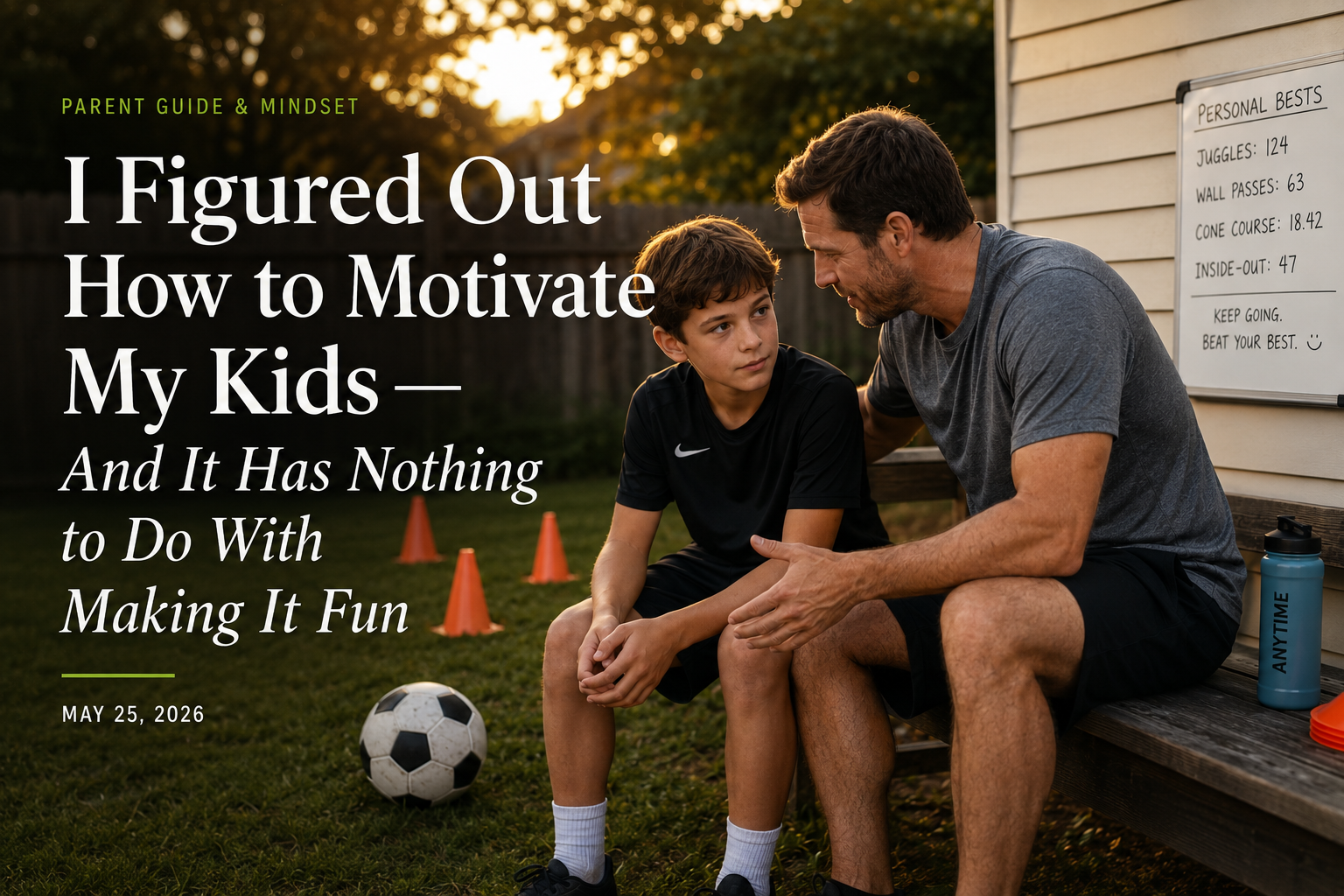
It was a Tuesday evening, and I was standing in the backyard holding a soccer ball, calling Matthew's name for the third time. No answer. I walked inside and found him exactly where I expected — on the couch, controller in hand, halfway through some game I'd never heard of. He glanced up at me with that look every soccer parent knows: please don't make me go outside.
"Five more minutes," he said.
It wasn't five minutes. It wasn't ten. By the time we actually got outside, I was frustrated, he was resistant, and the next twenty minutes were about as productive as you'd imagine.
I drove to practice the next morning thinking: Why is this so hard?
He loves soccer. He begs to go to games. He watches it on TV. But the moment I asked him to practice at home, it felt like I'd asked him to clean the bathroom.
If you've been in that spot, you've probably heard the same advice I heard a hundred times: just make it fun.
And look — they're not wrong. Fun matters. But "make it fun" is not a framework. It doesn't tell you why your child is resisting, or what to do when the fun isn't enough, or how to build something that actually sticks past a single good session. I spent years chasing fun and getting inconsistency. What finally worked was understanding something much more fundamental — and once I got it, the whole thing clicked.
From the Podcast
Neil's Framework for Lasting Motivation
Listen to the full episode of The Inside Scoop, then read the framework below.
What Motivation Actually Is
Here's the honest definition I use now: motivation is your child's willingness to do something today for a benefit they won't feel until later. That's it. It's the ability to engage in a delayed gratification activity — and that's genuinely hard for kids, because their brains are wired for now.
When I understood that, a lot of my frustration disappeared. Matthew wasn't being lazy — he was being a normal eight-year-old with a normal eight-year-old brain. My job wasn't to override that — it was to make the delayed-gratification loop short enough that he could actually feel it.
This is also why "just make it fun" gets you only so far. Fun solves the immediate resistance. But motivation that lasts is built when your child can see the result of what they're doing. Fun is the entry point. Visible progress is what keeps them coming back.
Related Reading
The 10-Minute Habit: How to Make Home Soccer Training Stick
Motivation gets you started. Habit is what keeps you going. This post covers the exact 4-step system for turning home training into something that just happens — automatically, every day, no willpower required.
Quick Tip
Shorten the feedback loop. After every session, point to one concrete thing that's better than it was last week. "That turn — you did that automatically. Two months ago you had to think about it." Make the progress visible.
The Prerequisite: Growth Mindset
Before any strategy works, your child has to believe that practice does something. If they believe ability is fixed — that they either have it or they don't — no training plan will help. They'll either coast or give up.
When Adam hit a wall around age ten, it wasn't laziness. He'd been putting in real work but not seeing the results he expected. His friends seemed to be improving faster (they probably weren't, but perception is everything at that age). He was quietly frustrated, and that frustration was coming out as resistance.
The fix wasn't a better training plan. It was a conversation. And the single most important thing I said:
Not "you're so talented." Specific. Observable. Tied to effort, not identity. That's the sentence that builds growth mindset. Kids who believe improvement is real will practice. Kids who don't, won't.
Quick Tip
Swap praise of talent for praise of process. Instead of "You're so good at this," try "I can tell you've been working on that — it shows." One habit, big difference.
The Right Strategy: Touches Over Everything
But finishing is the only thing kids will do on their own — they want to kick around with their friends. And even when they do work on it with you, they don't want to do the kind of reps that actually move the needle.
Ball mastery changed everything. Close-control, quick-feet work — the kind of repetitive, ball-at-your-feet training that builds the neural pathways that make the game feel effortless. Twenty minutes of real ball mastery produces more meaningful touches than an hour at a game when you barely play. More touches = faster visible progress = feedback loop tightens = motivation goes up on its own.
The irony: letting them do what's fun in the short term (shooting) at the expense of what builds the fastest visible progress (ball mastery) actually works against long-term motivation. For structured progressions, see the gear we actually use.
Free Resource
Get Your Free 4-Week Training Plan
A done-for-you home training plan built around ball mastery progressions — no equipment required, works for any age group.
Download Free Plan →Quick Tip
Start with 10 minutes of pure ball mastery before anything else — even if they'd rather shoot. The feet get sharp, confidence builds, and they usually want to keep going.
Autonomy: Real Choices, Not False Ones
There's a version of "giving choices" that backfires: false choices. "Do you want to practice today — yes or no?" isn't a real choice. It's a question with a wrong answer, and kids know it immediately.
Real choice: "We're going outside for twenty minutes. You pick what we work on first." The training is happening — that's non-negotiable — but they have genuine ownership over the shape of it.
Technology helps here more than I expected. When Matthew could open an app and choose his own drill video, the buy-in was completely different. He'd spend five minutes choosing before we even went outside. By the time we got to the backyard, he was already invested.
Quick Tip
Give three real options every session: "Ball mastery, shooting practice, or free juggle challenge — your call." All are valid. The choice creates investment before you even pick up a ball.
Lead by Example
Kids watch what you do more carefully than they listen to what you say. If I spent my evenings on the couch telling Adam to get off his video games, the message I was actually sending was: screen time is how adults relax, practice is what kids have to do.
The moment I stepped off the "coach" pedestal and picked up a ball myself, both boys responded completely differently. I wasn't evaluating them anymore. I was playing with them.
When I laughed at my own bad juggling attempts, the whole dynamic changed. He stopped feeling evaluated. And somewhere along the way, he stopped needing to be invited outside at all.
Quick Tip
Ask your child to teach you something once per session. "Show me that move" or "how do I do that footwork?" Kids who feel like experts don't dread going to practice.
Making It Uneventful
The goal, ultimately, is for home training to become so routine that it stops feeling like a decision. Not an event. Not a negotiation. Just what we do on Tuesdays and Thursdays. Like dinner. Like homework. It's just part of the week.
"Event" training — the big formal sessions you announce — creates pressure. Routine training becomes part of the landscape of the week. Less drama, more consistency.
Quick Tip
Pick two fixed days and put them in the family calendar. The battle isn't "will we do it?" — it's just "which drill first?" That small shift removes most of the friction.

Recommended Read
The Must-Have Guide for Serious Soccer Parents
Everything you need to know about supporting your child's soccer development — from choosing the right club to building the right home environment.
Read the Guide →The Checklist: Setting Up a Session That Actually Happens
⏰Before
- Good headspace? (Hungry / tired = reschedule)
- Time limit set? (20–30 min is the sweet spot)
- Asked if they'd like to pick the first drill?
- Know what they've been excited about lately?
⚽During
- More praise than corrections?
- Participating, not just watching?
- At least one free-play window?
- One specific win acknowledged?
✓After
- Ended on a high note?
- Skipped the post-session critique?
- Expressed genuine enjoyment?
The Do's and Don'ts
✓ Do's
Start shorter than you think. 20 focused minutes beats a dragged-out hour.
Celebrate improvement, not performance. Hold up the mirror — they can't always see their own progress.
Use video. Watch pros together, then go replicate the moves. Screen time feeding training time.
Let sessions fail sometimes. Bad energy today = short session, come back tomorrow.
Let them teach you. Kids who feel like experts want to practice more.
✗ Don'ts
Connect training to game failures. "You lose the ball because your first touch is bad" kills motivation.
Correct every mistake. Max one correction per session. Let everything else go.
Use training as punishment. Soccer is the reward, not the stick.
Compare them to others. Siblings, teammates, YouTube prodigies — all poison for intrinsic motivation.
Push through genuine resistance. Back off. Have a conversation. It's usually about something else.
Competence Builds Confidence. Confidence Makes It Fun.
Here's something nobody tells you at the start: the fun you're trying to manufacture in the backyard today is not the only kind of fun that matters. There's a different kind — deeper, harder to explain, and impossible to shortcut. It's the fun that comes from being genuinely good at something. From being selected. From belonging to something you earned your way into.
The three things are inseparable: competence, confidence, and fun. When a player gets measurably better at something, they feel capable. When they feel capable, the game becomes more enjoyable — not just fun in the "I-want-to-go-home" sense, but fun in the way that makes them want to push further. And when they enjoy it at that level, the training takes care of itself. The backyard sessions weren't just building skill. They were building access to a better kind of fun.
As I write this, Adam is an Academy player in Charlotte — one of the most competitive youth programs in the region. Matthew is in the CLT Discovery program. Both of them got there the same way: Tuesday and Thursday evenings in the backyard, sessions that felt ordinary at the time, progress that was invisible week to week but undeniable year to year.
That's fun. Watching your son be selected. Watching him compete at a level that asks everything of him and seeing him belong there. That's an accomplishment you cannot give a kid. You cannot buy it, you cannot arrange it, and you cannot skip the work it took to earn it. The only path to that kind of fun runs directly through the sessions that feel the least fun — the ones where they'd rather be inside, where the ball isn't cooperating, where the progress is invisible.
Those sessions are the investment. The Academy uniform, the Discovery roster spot — those are the return.
The Payoff
The fun on the other side is different from the fun you're trying to create today.
The fun of being selected — of competing at a level you earned — is only available to kids who did the boring work early. That's the longer game you're playing in the backyard.
Something to Remember
The discipline and consistency you're building today are not in competition with fun. They're the prerequisite for a deeper, lasting kind of it. Protect the process — and trust that the payoff is coming.
The Bigger Picture
When I watch Adam and Matthew play now, the thing I'm proudest of isn't their ability — although watching their growth has been one of the great joys of my life.
What I'm proudest of is that they still want to play. They're not burned out. They're not grinding through a sport they secretly hate. They still go outside on their own. The love of the game is still there.
That doesn't happen by accident. It happens when parents protect the joy instead of just developing the skill.
Ready to Make It Easier?
Build the Habit With a Plan That Does the Thinking For You
Thousands of drill videos organized by age and skill level. You show up. We handle the curriculum.
Start Your Free 7-Day Trial →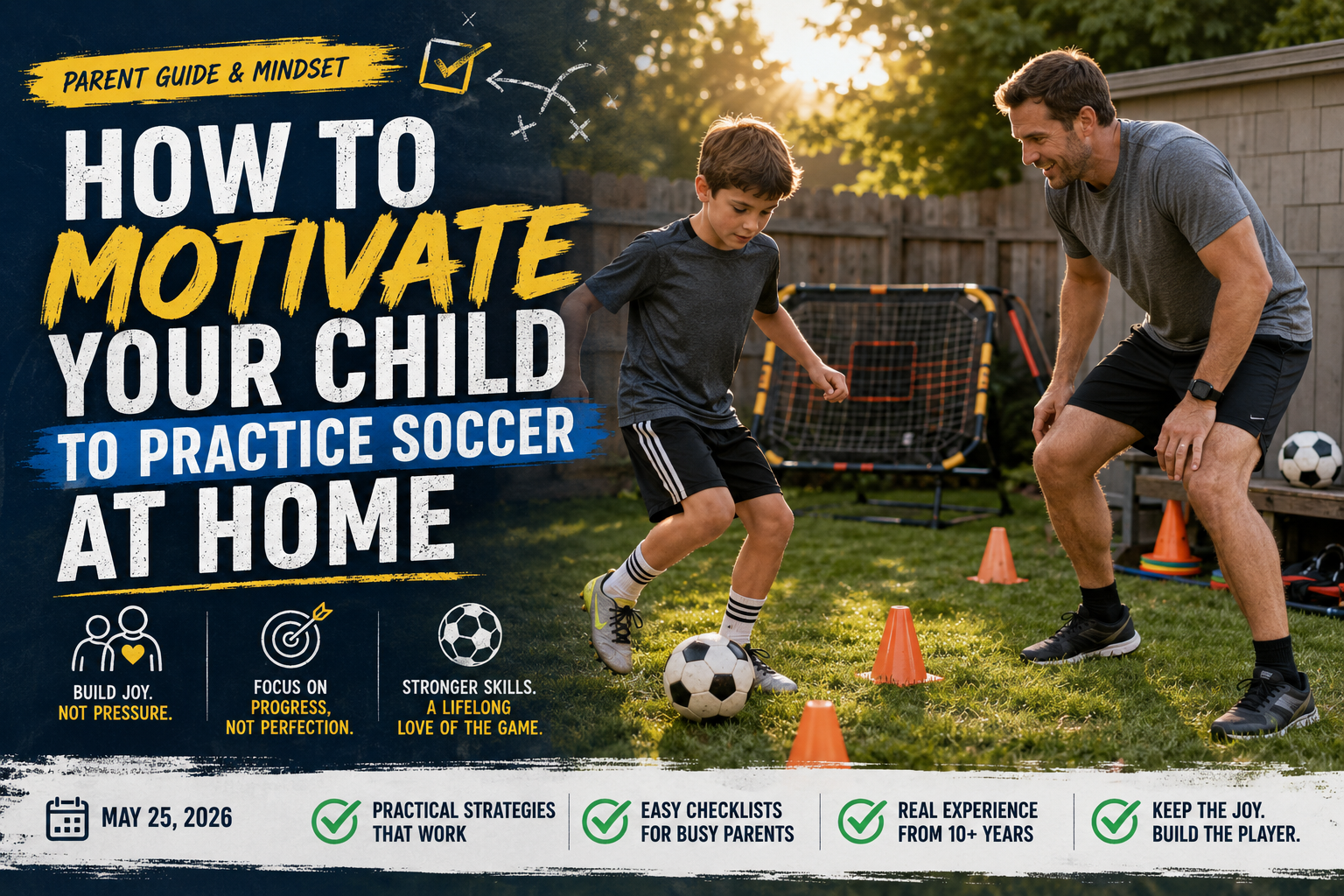
About the Author
Neil Crawford
Founder of Anytime Soccer Training and soccer dad to Adam and Matthew. He built the platform because he couldn't find one that worked for real families with real schedules — and because he made enough mistakes in his own backyard to fill a book.