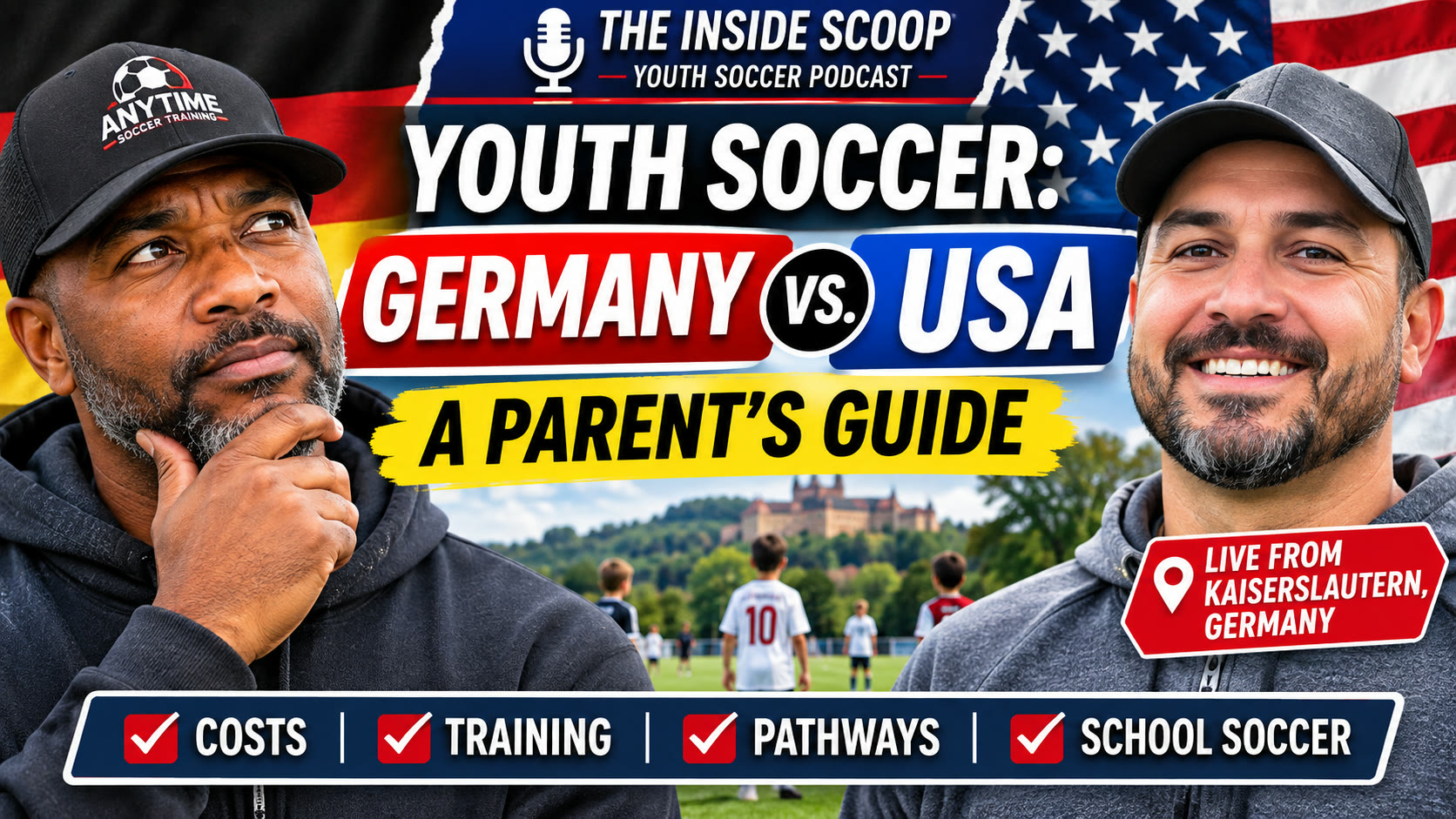
The Inside Scoop · Episode 5
By Neil Crawford · The Inside Scoop, Episode 5 · Nov 24, 2026
Germany runs youth soccer almost opposite to the way the United States does: one national governing body, a club in nearly every village, fees that are a fraction of American ones, and a fixed training schedule that parents do not get to negotiate.
In this post
- The American side in brief: get your wallet out
- Why the American system is pay to play
- Germany: one governing body and a club in every village
- What joining a German club looks like
- How talented kids get noticed
- Extra training: soccer schools, private centers and home practice
- Who coaches, who pays, and the village rivalries
- The two systems side by side
- Sideline behavior: a 180
- Early specialization: a culture, not a plan
- Why the gap shows up between 13 and 16
- COVID-19 in 2020
- Five takeaways for parents
I started The Inside Scoop to understand how youth soccer works in other parts of the world, and to help parents see the pathways that would be open to their kids if they lived somewhere else. For Episode 5 I went to Germany, through a guest who knows both sides of the Atlantic. Tony Rocha is a parent with American roots in Texas who lives in Kaiserslautern, a city of about 100,000 people roughly 30 minutes from the French border and an hour from Frankfurt.
Tony is in the military, and his family has been in Germany for six years: two in Bavaria, then four in Kaiserslautern. When they arrived, his two sons were nine and six. By the time we recorded, they were 15 and 11. That makes their experience unusual and useful. They only really know the German system, because they arrived just as the boys were getting started in recreational soccer, but Tony grew up with the American one and can see where they differ.
One caveat before we dig in. We recorded this conversation in late June 2020, in the middle of the pandemic. Fees, rules and league details may have changed since, so treat this as Tony's parent's-eye view from that time rather than an official guide.
The American side in brief: get your wallet out
Key point
The way I like to run these shows is to give a quick overview of the US system as I see it from Cary, North Carolina, and then compare it with the guest's country. So I asked Tony to pretend his eleven-year-old was moving to Cary and wanted to get into soccer. My first piece of advice would be to get your wallet out.
How much you pay depends on how competitive your child wants to be and what your family's goals are, but you will pay. The US is an overarching pay-to-play system. There are a handful of entry points, and each costs a different amount of time and money.
Recreational. This is the version most of us remember from our own childhoods. Mom or Dad coaches, everyone has a good time, shin guards go over the socks and somebody brings snacks. It is usually one practice a week plus a game, and it runs from the youngest ages up to about 17. Municipalities and local governments run many of these programs, and so do clubs, including academy-level clubs, because recreational soccer is a revenue opportunity for them. A season is typically eight or ten games, with two seasons a year.
Challenge. This sits between recreational and travel. It is a little serious and a little recreational. A licensed coach might run one practice a week, and the team may enter tournaments against more competitive teams. The program runs a bit longer than a recreational season. I think it is a very good entry point for children who have no interest in going pro and parents who do not want to commit to four or five days a week at the field.
Travel and academy. This is the one most of us have heard about: three days a week of practice, weekend games and tournaments, select and elite teams, and tryouts. At the youngest ages, clubs often run what I call pre-academy teams. Everybody makes a pre-academy team, but the children are sorted into teams, usually by skill level, with names like gold, silver or platinum. When kids reach about U12 or U13, they can try to make an academy-level or travel team. Clubs with an academy program usually have a top team and another team just below it, and the kids on those teams are fighting for those spots. These are the children with college or professional aspirations.
Why the American system is pay to play
Key point
The reason is structural: American professional leagues are closed, with no promotion and relegation, so clubs have no built-in incentive to create academy systems the way European clubs do. In their place, a market has grown up, and parents are the customers.
That has some consequences that surprised Tony, and that I think many American parents do not stop to consider:
- Even the top teams charge. At most clubs, parents of the best kids still pay. The big exception I mentioned is many MLS clubs, where players on the top team do not pay. A few kids are also recruited into boarding situations where the club covers the cost. In general, though, even at the highest levels, you pay.
- Clubs field a lot of teams. A European academy might have one team per age group. Here, a club just below MLS level might have 30 or 40 teams. I am not criticizing that, because the revenue helps finance the program. It also pays for training that kids who lack the skill or motivation to make an elite team would not otherwise receive.
- The flip side is real. There are children with the skill and motivation who never get that level of training because their families cannot pay. It is a big set of pros and cons.
School soccer
Once a child reaches middle school, around 11 or 12, they can play on a school team. But many academies will not let their players do both. The top team will not allow its players to play high school soccer, while the team just below it often does. Clubs argue that they have a development program built specifically for these children, and they do not want school training to interfere with it. That is a relatively recent development.
Futsal and independent clubs
Children can also play futsal. There are clubs outside the mainstream US Soccer system that focus on development. If you and I formed a club in North Carolina, hired excellent coaches, got our insurance and recruited a team, in the eyes of US Soccer we would still be a recreational team on paper. We could play in tournaments against academy teams, but we would not be officially recognized.
US Soccer and US Club Soccer
That leads to the two governing bodies. US Soccer is the equivalent of England's FA. US Club Soccer is a nonprofit, independent organization that has gained a lot of traction over the last couple of years. Both issue player cards that confirm players are legal and insured and are not on more than one team. Both offer coaching development and national and regional tournaments, and both let you win cups.
US Club exists because of a quirk. To join US Soccer, a new club typically needs approval from the existing member clubs in its area. In a pay-to-play system, how often do you think established clubs approve a new competitor? Never. US Club Soccer is national rather than regional, and as long as you meet basic criteria, you can become a member and compete against other member clubs. That is why there has been such a push toward it.
Germany: one governing body and a club in every village
Key point
As Tony described it, German youth soccer feels far more nationalized than the American version. One body governs it, the DFB, the German football federation, and every club feeds into it.
Age groups work much as they do in the States, with U11, U13 and so on. What is different is how soccer is organized on the ground. Nearly every village has a club, and in many towns soccer is the only sport on offer. Clubs offer programs for children from the youngest ages, around U6, all the way through U17, and then adults play for the same club. Tony pointed out that there are even teams of men in their 50s and 60s who still play for the village.
I compared it to the local pub. Pub culture is hard to explain to anyone who has never experienced it: it is our local, it is an institution, and somehow it survives with two or three people in it. A German village club feels like that. It is just a field, maybe a concession stand and dressing rooms, and often a restaurant. It is not a grandiose operation.
The other big difference is promotion and relegation. In the US we talk about it as something professional leagues lack. In Germany, Tony explained, it runs all the way down: every team has promotion and relegation, even youth teams, starting around U11. Tony believes U11 is also the age where Germany starts seriously identifying talent. Before that, he thinks, the focus is developmental. At about ten or eleven, the best players start to be separated from the recreational ones.
What joining a German club looks like
Key point
For a new family, it is remarkably simple. When Tony's family arrived, neither he nor his boys spoke German. They walked down to the local club and said they had a son who wanted to play. The club was welcoming and put him on the team.
From there, things work differently than in the US:
- One team per age group. A club has one team for each birth year. If you are in the 2008 group, that is your team, and it is made up of whoever is in that year. There are no gold, silver and platinum versions of the same age group.
- Small-sided games. Tony says U11 plays seven-a-side. No matter how many kids are on the roster, only seven play that weekend.
- One long season. There are no two short seasons. It is a single season that runs all year. In winter, play moves indoors, with indoor tournaments for the same team against the same villages.
- Not everyone plays. Tony was blunt about this: Germany is not a place where everybody gets a trophy. If you are good enough to play, you play. Kids who are not make up the training pool, and they train without playing many games. Friendlies are where more kids get minutes, and some may be brought on for two minutes.
What if my child just wants to play for fun?
I pushed Tony on this because it is the first question many American parents would ask. His answer was that clubs will not turn your child away. Your child joins the training pool, and the coach selects kids from the pool to play in games. What changes is that a city of 100,000, like Kaiserslautern, has several clubs. The best club attracts the best kids and has the best program. A child who is in the middle, or who just wants to be with friends and get more game time, can look for a less competitive club.
Some clubs hold tryouts and some take anyone. Those playing in the lower leagues tend to accept everybody, especially as boys get older, lose interest, or move on to other things.
What does it cost?
Tony said his youngest son's team costs about 60 euros for the whole year, and he was not even sure what the fee covers. It does not pay the coaches. He assumed it went toward ancillary costs such as field fees. Compare that with what American families pay.
How talented kids get noticed
Key point
My ten-year-old son is technical, and a lot of parents of kids like him ask me the same thing: if my child is lights out, what is his path? Does he have to sign up with the local club and hope? Does Borussia Dortmund hold open trials?
Tony's answer was that in Germany the first step is the same as any other child's: play for a local club. The difference is how closely everyone is watching.
Kids are known early. German children often start playing around age three, in the club's youngest teams, which Tony called Bambini. Many come from families with ties to the club, so the clubs already know them. Because village teams play against the same clubs twice a year, coaches from other clubs watch these kids develop over the years. Scouting, as Tony saw it, mostly means watching known kids grow up inside the system.
Leagues mix village and professional clubs. At U11, Tony said, the leagues stack up about four levels high. The lowest is the recreational league, and the highest includes the youth teams of Bundesliga clubs. So a village team can end up playing a professional club's youth team. If a player is doing extremely well in their league, they get noticed. Tony also believes professional clubs recruit from a radius of about 100 kilometers around the club, though he said that was his understanding rather than something he knew for certain.
There is a national talent identification program. The DFB runs talent identification centers around the country, which Tony described as roughly one per county or region. A club coach who sees an especially good child, often at nine or turning ten, sends them to a tryout at the center. Tony's youngest son went, was selected and joined. He still plays for his own club, but once a week he trains at the center with DFB-licensed trainers, in his own age group. Tony thinks the program runs up to about U15 to U17.
So a system that looks informal from the outside does have a structured path for talented kids, and it starts with a coach's recommendation.
Switching clubs
Two rules stood out. First, a child who joins a professional academy leaves the local village club. They do not play for both. Second, switching clubs can only be done in two windows a year, summer and winter, and it requires an actual application to move the player's card from one club to another.
Extra training: soccer schools, private centers and home practice
Key point
The question I always ask parents whose children have had any success is what they did at home. Tony was candid. His in-laws are from South America, where soccer is the true sport, so the boys started playing around age three. His youngest also had an older brother to compete with, and has always wanted to be better than him.
Tony did some training with them himself, but admitted that it was hard to come up with what to train, especially as a parent with a military schedule that does not always leave time. So the family supplemented with outside options:
- A professional club's soccer school. In Germany, professional clubs typically run a football school. Tony's family used the one run by FC Kaiserslautern, a big, historic club that was in the third league at the time of recording and had been higher a few years earlier. Tony said it cost somewhere between roughly 120 and 150 euros for a set number of sessions over a period of time, one session a week.
- A private training center. The family also used a local private center on and off, again once a week.
The American equivalent is the clinic, and I send my own boys to one. Clinics and soccer schools both give kids specific technical training outside a team environment. What Tony pointed out is different in Germany is that the soccer schools are run by professional clubs with a tradition of developing players.
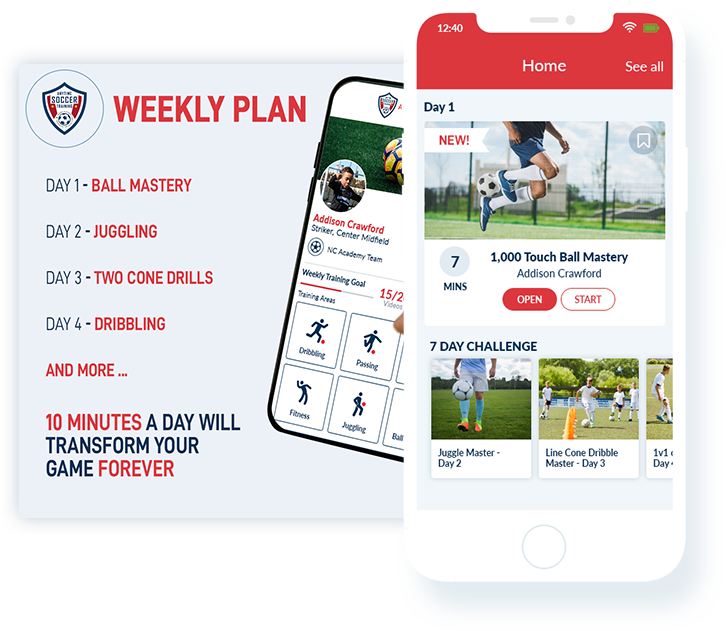
The Part You Control
Extra Training at Home, Without Guessing What to Do
Whatever system your child plays in, the extra work usually falls to the family. Anytime Soccer Training gives you 5,000+ follow-along videos (ball mastery, juggling, first touch and more) in a set order, so you always know what to do next.
Try It Free for 7 Days →How good is the coaching?
I asked Tony to compare the coaching at the regional talent center, which I treat as a proxy for academy-level coaching, with what his sons get at their club. At the center, he said, training is better organized, uses different drills and is at a higher level. Part of the reason is that the center is full of kids who play at a high level and want to. At the club, it depends on the coach. A coach who takes the time to build a training plan produces good training, and one who does not, does not. That is the same as in the US.
He also noticed that his sons' experience has been shaped by their competitiveness. Both boys wanted to be competitive, and Tony said the family pushed them as much as they wanted to be pushed. Even recreational German soccer is not truly recreational: the kids who play are the ones who know how to play the game, even at nine or ten.
Who coaches, who pays, and the village rivalries
Key point
In the US, having a paid coach is considered a selling point, and "volunteer coach" tends to mean a mom or dad whose child plays on the team. In much of the rest of the world, I have heard a different meaning. Coaches in Europe and Africa have told me they volunteer because they are studying for their licenses, earning their first badges, and want experience so they can eventually work in academy football. So I asked Tony which kind of volunteer German coaches are.
His answer, based on the teams his sons have played for, was that most coaches are volunteers and many are parents. But the culture is different. Soccer is the only sport in many villages, and the parents who coach have often played their whole lives and are still playing. Many hold coaching licenses. They coach because it is their town and their club, and they want to see it progress. They raise money through sponsorships and stay closely involved.
Rivalries make recreational soccer competitive. Every village has a rivalry with a neighboring village, and the coaches want to beat them. So even at the recreational level it is competitive. When I interviewed someone from Ghana, he described the same thing, with regional rivalries driving coaches to push their training harder. You can decide whether that is healthy or not, but it is the culture.
Where the money comes from
Tony did not know the details, but he believes the clubs get some support from the government or the village. I offered a few ways clubs like these could be funded, with the caveat that I was thinking out loud rather than describing Germany:
- A national sports agency distributes money to different sports, and part of it goes to soccer. The national federation then passes funds to grassroots and professional clubs.
- Professional clubs share a percentage of their revenue with the federation, which in turn finances grassroots soccer.
- Municipalities contribute through taxes, local initiatives and grants, and clubs also fundraise.
The one thing Tony stressed is how modest these clubs are. As he said, a club may not be much more than a field, a concession stand, dressing rooms and a restaurant.
The two systems side by side
Key point
Here is how Tony and I saw the main differences, as of the 2020 conversation.
| United States | Germany | |
|---|---|---|
| Governing body | US Soccer and US Club Soccer | DFB, the one national federation |
| Who pays | Parents, even for most top teams | Small yearly club fee (about 60 euros for one youth team) |
| Promotion and relegation | Not in professional leagues; no built-in incentive to build academies | Runs all the way down, including youth teams from about U11 |
| Teams per age group | Many, sorted by skill (pre-academy, gold, silver and so on) | One per birth year at village clubs |
| Season | Usually two seasons a year | One season that runs all year, indoors in winter |
| Choosing your commitment | Clubs sell programs by days per week | Club sets the schedule; youth teams typically practice twice a week |
| Everyone plays? | Recreational leagues are relaxed and come-as-you-go | Good enough to play, you play; the rest train |
| Coaches | Paid coaches are a selling point | Mostly volunteers, many of them parents with licenses |
| Talent identification | Club and academy tryouts | Club coaches, village rivalries, and DFB talent centers |
| Switching clubs | Not covered in our conversation | Two transfer windows a year, with an application |
| Sideline coaching by parents | Common | Rare, and frowned on |
The row about choosing your commitment shows the biggest difference in philosophy. In the US, a club will tell you it has a one-day-a-week program and a three-day-a-week program, and you pick based on your budget and your child's goals. A German club will tell you it practices Tuesdays and Thursdays and that is when you can come. If you see something special in your child and want more, Tony said, you have to look for extra training or do it yourselves. Higher-level clubs train four or five times a week as the kids get older, but not every day.
Sideline behavior: a 180
Key point
Parent behavior on the sidelines is an increasing problem in American youth sports, and Tony has seen enough online to know it. The stereotype is real: at nearly every game in America there are parents coaching from the sideline, giving instruction at a minimum and yelling at a maximum. So I asked him how the German sidelines compare.
His answer was that it is about a 180. It does happen occasionally, but what he sees more is parents getting into it with referees, and sometimes coaches doing the same, mostly at older ages where games can get more physical and a player may deliberately kick another. A parent coaching their own child from the touchline, though, does not happen for the most part. When it does, it is considered very uncouth.
Tony sits among the German parents and said they are all biting their tongues and want to say things, but it is simply not the culture. The coach coaches, and the players know what they are supposed to do. Once in a while a parent says something, and sometimes it is in German so he does not understand it. But the viral videos Americans see are not what a typical German sideline looks like.
There is a lesson in that for American parents, whatever country you live in. Your child already has a coach. Your most useful job on game day is to support, not instruct.
Early specialization: a culture, not a plan
Key point
Early specialization is a hot topic in the US, where kids can play basketball, American football, baseball and more, and superior athletes often play one or two of these competitively. I always ask guests from other countries how they see it.
My own view, offered as a parent and not a doctor, is that the risk is not low-impact ball mastery. I steered my sons toward soccer on purpose, because I wanted a sport without the contact of football and with lots of running. My oldest enjoys flag football and I have signed him up for recreational basketball, and he still trains with me in the offseason. The problem many American parents face, I believe, is signing a child up for multiple leagues and teams so that they play 60 or 70 games a year. That raises the risk of overuse injuries and demotivates the child, because the game starts to feel like a job. My one asterisk is repetition: structured, repetitive training is different from the free play Tony described, and I want to bring a doctor on the show to talk about it.
Tony's perspective was that in Germany, specialization is more cultural than intentional. His boys played other sports before the family moved, and they have occasionally done recreational sports in Germany. But the soccer calendar runs all year, with indoor tournaments in the winter, and the local economy offers fewer other sports than American communities do. Other sports often conflict with soccer training or games, so the family often had no choice. All I could say was, welcome to the club.
Why the gap shows up between 13 and 16
Key point
After we stopped recording, Tony and I kept talking, and I asked him to say it again on the record. His family has an unusual vantage point. Tony is military, so he sees not only his own sons but other military families whose children arrive in the German system at different ages. We talked about his older son, who was older when the family arrived, and what the transition was like in terms of talent level.
Where we landed, with the caveat that there are always exceptions, was this: at the younger ages, German and American talent is comparable. German kids probably have a better feel for the game because of all the free play, which shows up later. In general, if your child plays at the level of travel soccer in the US, he will fit in. I always talk about the 20 percent rule: roughly 20 percent of the kids are far better than the rest, 20 percent are far below, and everyone else is in between.
What we know from the US national perspective is that something happens at around 13, 14 and 15, where the divide starts to show. We are just two parents talking, so we do not know whether it comes from something at the foundational level that we cannot see or from something that happens at those critical teenage years through the influence of professional clubs.
Tony's view was that every year the children get older, you see more of a difference. He said that even among German kids, a player at a really competitive club dropped into a lower league at 13, 14 or 15 would stand out like night and day. He thinks it comes down to several things:
- German kids continue to touch the ball year-round, and the training at a competitive level is very good.
- By 14 to 16 they are already starting to become professionals, in his words, at around the age of 16.
- Competitive American academy players tend to do okay in Germany, including at higher levels, but he sees a difference in how kids control the ball and understand the game.
The incentive is the other piece. In Germany, clubs have to keep developing their teams, and in some cases sell players to bring in money. In the US, MLS clubs stay at the top level whether or not they develop youth, so there is no pressure to. Until that changes, Tony does not expect the US to come close, unless a whole crop of American kids plays in Europe and comes back. We both agreed that is probably our best hope. Tony mentioned that David Beckham's sons were born in the States, and that other English players' sons may be able to get citizenship.
Gear that helps
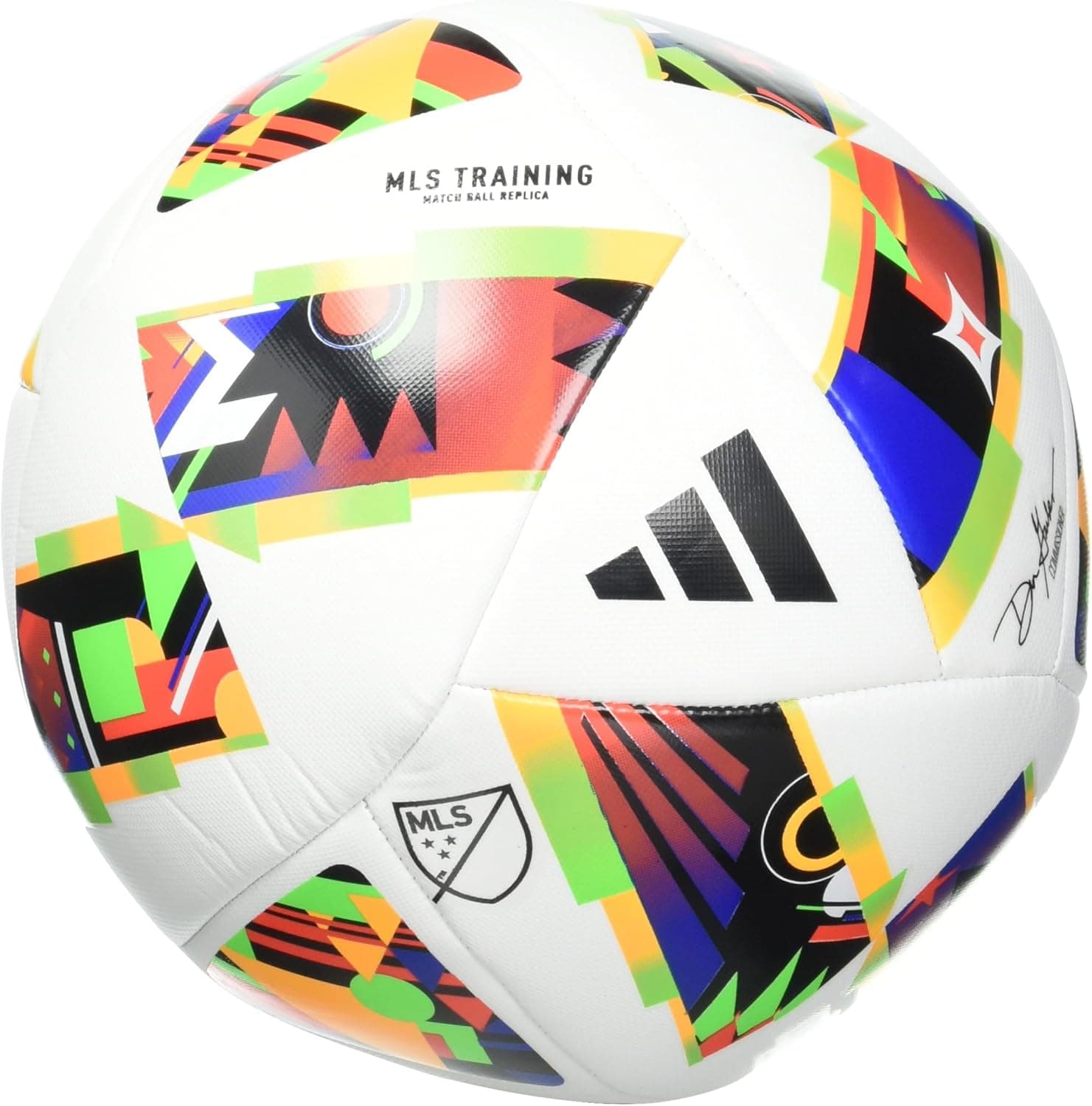
Adidas MLS Training Soccer Ball
A durable size 4 or 5 ball for every session at home.
See it on Amazon →COVID-19 in 2020
Key point
We recorded on June 26 or 27, 2020, so I asked Tony where things stood with the pandemic. Germany had opened up significantly, most stores were open, and soccer training had started again. Because it was already summer, the usual break was coming, when teams reshuffle between seasons. The season had been suspended in March and then canceled. As Tony understood it, teams that had won their league moved up, but nobody moved down, and the following year would probably see more teams move down to rebalance the leagues. The family was hoping next season would start as normal.
Five takeaways for parents
- Know how the system you are in is built. American pay-to-play and German promotion-and-relegation produce very different incentives. Understanding which one you are in helps you set realistic expectations.
- Find the entry point that fits your family. In the US, challenge-level programs are a good option for kids who want to play seriously but whose families will not commit to four or five days a week. In Germany, the village club is the front door for everyone.
- Plan your own supplemental training. In both countries, if you see something special in your child and want more than the club schedule, it usually falls to you. That means soccer schools, clinics or time at home. Tony's honest struggle with knowing what to train is exactly the problem Anytime Soccer Training exists to solve.
- Keep sideline coaching to the coach. The German sideline is a reminder that kids do better when the coach coaches and parents support.
- Watch the calendar. Whether the risk is 60 or 70 games a year in the US or a year-round schedule in Germany, overload is easy to fall into.
Gear that helps
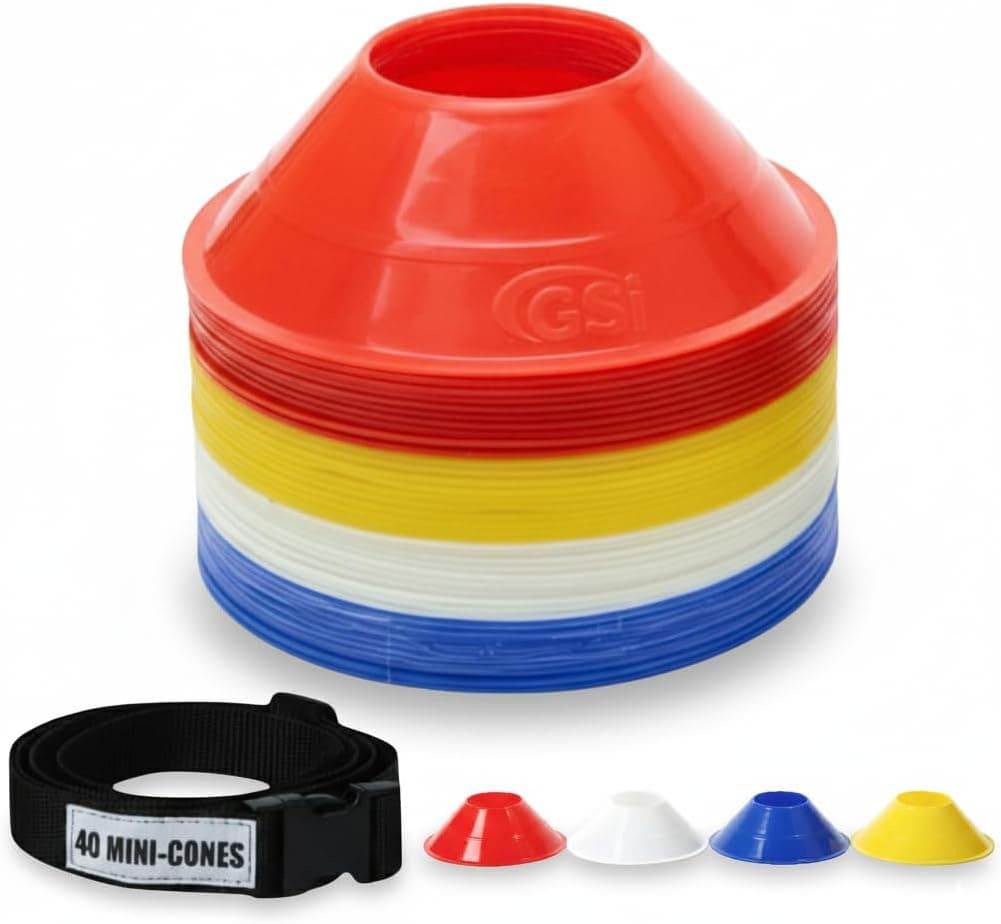
Disc Training Cones (Set of 40)
Enough for boxes, weave courses and anything else you set up in the backyard.
See it on Amazon →I created this podcast to find other parents as passionate about this as I am, and to help empower parents to help their children. Many thanks to Tony Rocha for such a generous conversation. And when his son makes the German national team, I hope he saves Uncle Neil some tickets, because I will fly out there.
You can get free ball mastery and juggling videos from Anytime Soccer Training at anytime-soccer.com.
As an Amazon Associate, Anytime Soccer Training earns from qualifying purchases. Gear links in this post are affiliate links; they cost you nothing extra.