
Pay to Play & The Cost of Club Soccer
Every spring, parents across America open their email, see a registration invoice from their child's soccer club, and feel the same slow burn. Another year, another four-figure bill. The conversations that follow are always the same: clubs are greedy, the system is broken, and in Europe they do it for almost nothing.
I've had that conversation more times than I can count. And I've been frustrated too — I write a check every year and feel every dollar of it. But after spending a lot of time thinking about this, reading about it, and talking with coaches and parents across the country, I've come to believe that the popular framing of the problem is mostly wrong.
The clubs aren't running a racket. The coaches in Spain aren't magic. And the solution isn't as simple as "just make it cheaper."
Here's my attempt at an honest breakdown — covering both sides of the equation that almost nobody talks about together.
From the Podcast — The Inside Scoop
Why Is Soccer So Expensive in America?
Neil breaks down the supply and demand forces behind the cost of club soccer — listen to the full episode below.
Start With the Framework: Supply and Demand
Every pricing question — for anything — comes down to two forces: supply and demand. The supply side is the organizations and people providing the service. The demand side is the consumers willing to pay for it. When people ask why club soccer costs what it costs, they're almost always only looking at the supply side — the clubs, the coaches, the fees. They're ignoring the demand side almost entirely.
That's the first mistake. And it leads to the wrong diagnosis, which leads to the wrong solutions.
Takeaway
Before blaming the club, ask: what are we actually demanding — and who else is willing to pay for it at this price? The answer changes the whole conversation.
The Demand Side: An American Cultural Story
Here's something that's genuinely different about the United States: a significant segment of American parents are willing to pay for professional-level, high-volume sports training for kids who have never been scouted, never demonstrated elite potential, and may not even want to play professionally.
That's not an insult. I'm one of those parents. But it's worth naming clearly, because it drives everything else.
There's something deeply American about it. The cultural belief is: if you give us access to the same resources and opportunities as anyone else, we can make it. That's a beautiful thing. It's also what creates a market where families invest heavily in youth sports before their child has proven they need that level of investment.
Travel sports — not just soccer, but basketball, baseball, lacrosse — plays an outsized role in a certain segment of American life. This is a cultural reality, not an intrinsic flaw. But it has real consequences for pricing.
Takeaway
The European academy model only serves the top 1–2% of players. It's not a template for mass youth development — it's a talent extraction system for already-identified elite kids.
What We Lost: The Volunteer Model
There's a version of youth sports that used to exist in America — and still exists in much of the world — that we've largely abandoned. My dad coached baseball in the community. He didn't get paid. He coached five days a week, ran his own Little League, and did it because that's what parents did.
When he was younger, my son played in Hispanic rec leagues. The coach wasn't polished in year one. By year five, he was excellent. The team practiced four or five days a week. They traveled and won tournaments. It was volunteer-based. The cost was almost nothing. And the quality was real.
That model works because it compounds. A parent who starts coaching at age five has seven years of experience by the time their kid is twelve. They've networked with other coaches. A second child means thirteen years combined. By the time they're done, they're genuinely good coaches — because practice makes you better at anything.
We traded that model for a paid professional one. The trade-off was intentional — we wanted more. But it came at a cost.
Takeaway
The volunteer model didn't disappear because it was bad. It disappeared because a segment of parents demanded more volume, more structure, and more professional delivery — and were willing to pay for it.
Worth Noting
There are still many good volunteer-based clubs out there working hard to bend the cost curve — coaches and organizers who believe in keeping the game accessible and are building something real on a shoestring. They deserve more credit than the conversation usually gives them. We'll speak more to this in the supply side section below.
The High School Void — And Why This Isn't Just a Soccer Problem
There's another piece of this story that rarely gets mentioned: high school sports used to fill a significant part of this void. Not perfectly, and not at the intensity level club offers — but for generations of American kids, the high school program was where serious development happened. It was accessible, it was community-based, and the cost was built into the school system.
That's changed. And it's changed in a very specific direction: families with resources and ambition are increasingly opting out of the high school program entirely in favor of club. The club schedule conflicts with the school season. The club coach carries more weight in the recruiting conversation. The high school program is seen as a step down, not a complement.
But here's the thing: it's not just soccer. This is happening across virtually every American youth sport, and understanding that is important — because it means the problem isn't specific to how soccer is administered. It's a cultural and economic shift that has touched everything.
The pattern is identical across all of them. A segment of motivated, resourced families decides the existing system isn't enough. They build or buy into an alternative. The alternative becomes the perceived standard. The original system — rec league, school program, community club — is hollowed out. And the cost of participation for everyone rises.
Track and field is a particularly striking example. For decades, if your child could run, the school program was the only development pathway you needed. That infrastructure still exists — but increasingly, families who want college exposure or elite development are supplementing (or replacing) the school program with private club teams, speed coaches, and showcase meets that can rival soccer in their annual cost. A sport that was essentially free is no longer free, if you want to compete at the level that gets noticed.
AAU basketball is perhaps the most well-documented case. The AAU circuit has largely displaced high school basketball as the primary recruiting ground for college coaches. Which means if you want your child seen, you need to be on the circuit — which means you need to pay to be on the circuit. High school basketball still exists. But it's no longer the main stage.
Understanding this matters because it shifts the conversation. If soccer clubs were uniquely predatory, you'd expect to see lower costs in sports with different governance. You don't. AAU basketball has the same cost structure. Travel baseball has the same cost structure. The governing bodies are completely different — but the price points are remarkably similar. Because the demand is the same.
The Supply Side: US Soccer and the Consolidation Problem
On the supply side, the honest answer is that the governing bodies — US Soccer most prominently — have not created a marketplace that would allow competition to drive prices down.
In many markets, large clubs have entered into long-term field rental agreements with municipalities. They control the field space. They control the leagues. That combination makes it very hard for a new, leaner operator to enter the market and offer the same service at a lower price.
This isn't unique to soccer. In AAU basketball, technically anyone can start a team tomorrow. And yet AAU is still expensive — because the demand side hasn't changed. A volunteer coach isn't going to run four training sessions a week plus weekend travel tournaments. And that's not what most parents want anyway. So the price stays elevated regardless of the structural barriers.
The Coaching Talent Shortage Nobody Talks About
There is another supply-side angle that does not get talked about enough: the scarcity of the coaches themselves.
American parents — and this is a real cultural expectation, not a criticism — want a paid coach who has actual playing experience. Not just someone who watched a lot of YouTube. We are talking college level or above, ideally. Think about what that means mathematically. At any given time, only roughly 7 to 10 percent of the kids who play youth soccer go on to play at the college level or higher. That is your entire pool of coaches who meet the standard that most parents consider acceptable.
Illustrated
Finding the Coach American Parents Actually Want
Every dot = 1 youth soccer player. Red dots played college level or above.
Now filter that pool further…
Played at college level or above
… who actually want to coach kids
… who live in your market
… who are available Tuesday & Thursday afternoons
… who will work for what you think is reasonable 😬
This is why coaches cost what they cost. It has nothing to do with price gouging. It has everything to do with the fact that the people qualified to do the job — by the standard most families hold — are genuinely rare. And rare things in high demand are not cheap.
Now take that pool and ask: how many of them actually want to coach? Some go into other careers entirely. Some are not interested in working with kids. Some move away. The pool shrinks considerably. And then factor in geography — those coaches are dispersed across the entire country, across thousands of clubs, across hundreds of markets at every level of competition. You are not pulling from a deep, centralized labor supply. You are recruiting from a genuinely thin, geographically scattered pool of qualified people who know the game at the level families expect.
Basic economics: scarce supply plus strong demand equals higher prices. A coach who played Division I soccer and wants to coach U12s on Tuesday and Thursday afternoons has options. They know what they are worth. And clubs that want to keep them have to pay accordingly. This is not a negotiating failure. It is just the market working exactly as you would expect it to.
The supply side problems are real, but they're not the whole story — and fixing them alone won't solve the cost problem if the demand hasn't changed.
Takeaway
Structural reform matters — but it won't fix the price problem alone. Even in AAU basketball, where anyone can start a team, costs remain high because of what parents are demanding.
Also on The Inside Scoop
More from Neil on Pay-to-Play & the Future of US Soccer
A related episode continuing the conversation — going deeper on solutions and what parents can do right now.
The International Comparison Fallacy
The comparison I hear most often: "In Spain or Germany, they get this level of coaching and only pay a fraction of what we pay. Why can't we do that here?"
There are two things wrong with this comparison.
First: the grassroots coaches in Spain and Germany are volunteers or paid very little. The low cost isn't a feature of smart administration — it's largely a feature of free or near-free labor and culture. The moment you want those coaches to be paid professionals running four sessions a week, the cost goes up.
Second: the professional academies people are comparing to — Barcelona B, Bayern youth, Ajax — only serve a tiny percentage of the player population. They scout, they select, and they cut. If your child doesn't make the standard, they're not in. Those academies are not investing in average kids to see if they develop. That's so far from what they do that it's barely worth comparing.
Third: in Europe, clubs are not businesses. They are genuinely community institutions — membership organizations that collect dues, field multiple teams across age groups and genders, host social events, and serve the neighborhood in ways that extend well beyond soccer. They are woven into the fabric of local life in a way that has no real American equivalent.
Think of it like your local CPA doing the church's taxes for free, or a volunteer fire department staffed by people who live three streets over. There is a deep culture of community contribution built into these clubs that is not transferable by policy. A parent coaches not just because they love soccer, but because the club is their club — the same one their parents belonged to, the same one their neighbors belong to. The social obligation is real and it is self-reinforcing across generations.
An American soccer club, by contrast, is almost always a business — or at best, a nonprofit that functions like one. It competes for families. It markets itself. It lives and dies by registration numbers. The relationship between family and club is transactional, not communal. That is not a criticism — it reflects the context in which American clubs operate. But it means the social infrastructure that makes the European volunteer model work simply does not exist here in the same form. You cannot separate the low cost from the community context that produces it.
The Revenue Fallacy
There is a version of this argument that goes: European clubs can afford to run cheap programs because they generate revenue from training compensation fees, proceeds from the first team, and player sales. And there is some truth to that. Training compensation is real. Sell-on clauses are real. A club that develops a player who eventually moves up the pyramid does receive money. That matters, and it is worth acknowledging.
But that revenue is not what is covering paid coaching staff, facility costs, and administrative overhead at the level of a typical US club team. Not even close. The clubs generating meaningful sell-on revenue are operating at a completely different tier — they have identified and are developing elite talent, the kind of player who has a realistic pathway to professional soccer. That revenue flows back into elite development programs, not into subsidizing mass participation.
Said plainly: European clubs are not using first-team revenue or player sale proceeds to pay for average kids with average ability to receive ECNL or MLS NEXT level programming. That is not what is happening. The average grassroots player in Europe is coached by a parent volunteer on a community pitch, not cross-subsidized by Champions League prize money. The two tiers — elite and grassroots — operate almost entirely independently of each other financially.
When people point to the revenue streams of a Barcelona or a Bayern and suggest that is why European youth soccer is cheap, they are conflating two completely separate systems. The elite academy is a talent pipeline funded by professional club revenue. The grassroots club is a community institution funded by dues and volunteers. They share a country and sometimes a name. They do not share a budget.
A Real Example of the Misunderstanding
A parent jumped into an online discussion about the cost of US youth soccer and posted this comparison. It was well-intentioned — they were genuinely trying to put the numbers in context. And it illustrates exactly why this conversation goes sideways every single time.
A parent posted this in a community forum
"For better context, why don't you make a chart of actual levels of play and who pays what? For example:"
Neil Crawford
Reply
First, the cost figures here are off — most families at these levels are not paying $10,000. Costs vary a lot by region, club, and travel schedule. But honestly, the amounts are not even the main problem with this chart.
The bigger issue: this chart captures exactly the misunderstanding that makes this conversation so difficult. You cannot compare ECNL to a Championship academy — or to any professional academy. That is the core of the fallacy.
The kids playing ECNL in the US would not be in a Championship academy — or any professional academy — if they lived in England. They would be in grassroots. Full stop. Professional academies are for players who have been scouted and selected by professional clubs — players with a realistic pathway to professional soccer. That is a tiny fraction of the ECNL population.
The correct comparison for the average ECNL player in England is not a Championship academy — it is a local community club with a parent volunteer coach. Which costs very little. Because the level of investment is matched to the level of player. That is the part the chart misses.
What the chart is actually showing — without meaning to — is that in America, we have built a system that provides near-academy-level programming to average players, at near-academy cost. In England, that does not exist. If you are not good enough for the academy, you are in grassroots. There is not much in-between — there are leagues like JPL and others trying to fill that void, but nowhere near the scale of the US club soccer system. Whether that is better or worse for player development is a genuinely interesting question. But it is a very different system — and it is not cheaper because it is better run.
And here is what that actually means in practice: because the top 1–2% of players are absorbed into academies, the remaining 98% continue to play grassroots — and that grassroots pool is deep, competitive, and genuinely high-level. The average Sunday league player in England, the average third-division club in Spain, the neighborhood team in Brazil — they are operating at a standard that reflects generations of cultural investment in the game. The talent density at the grassroots level in those countries is a byproduct of that deep pool, not a result of any particular administrative structure. Most kids do not make the academy. Most kids keep playing. And the level they play at is high — because everyone around them is also good.
That cannot simply be imported. Which brings us to the second point people consistently miss: Europe has a historical and cultural context around soccer that is essentially impossible to replicate in the United States. In England, Germany, Spain, and Brazil, soccer is not one sport among many. It is the sport. It is woven into working-class identity, into neighborhood pride, into the rhythms of daily life in a way that goes back over a century. Kids play in the streets before they ever join a club. They grow up watching their parents watch it. The cultural transmission happens automatically, informally, and constantly — long before any coach or academy gets involved.
The United States is a country where soccer competes for attention with American football, basketball, baseball, and a dozen other sports — and where the sport itself arrived relatively recently as a mainstream youth activity. The infrastructure, the passion, and the talent density that make European grassroots soccer what it is took 100+ years to build. Pointing to those systems as a ready-made template for American reform ignores everything that produced them.
You cannot shortcut cultural history. You can learn from it — but you cannot copy-paste it.
Takeaway
If you want the European model, you also have to accept European reality: most kids don't get professional coaching. They get parents. The academy slots go to the kids who earn them.
What About Promotion and Relegation?
Pro/rel comes up in almost every conversation about fixing American soccer. And it is worth taking seriously — but before we can have that conversation, we need to be clear about what we are actually talking about.
Are we discussing pro/rel at the adult league level, or pro/rel at the youth level? Because those are two very different things — and they have two very different effects on cost.
The Adult Pyramid Argument
Most people raising pro/rel in this debate are talking about the adult pyramid — MLS, USL, and below. A connected system would attract foreign investment, create real competitive stakes, and open pathways for players being missed. That is largely true.
But it does not directly change what a family pays for their 12-year-old to train three days a week — with a paid coach, on well-kept fields, for ten months a year.
The counter-argument: pro/rel will spur the formation of new clubs across the country. Investors and communities organize, build clubs, develop youth academies underneath them. The pipeline builds from the top down. More clubs, more competition, lower prices.
There is something to this. But new clubs still need fields. They still need paid staff. They operate in the same real-estate market, the same labor market, the same insurance environment. The pyramid structure does not change the underlying cost drivers. A Tier 4 affiliated club is still paying what a qualified coach costs in 2025.
What People Miss: Accumulated vs. Investment Infrastructure
European clubs have been around for literally over one hundred years. What they have is not investment-created infrastructure. It is accumulated infrastructure — facilities owned outright, volunteer networks built across decades, community trust earned over a century of being part of local life.
That is a completely different thing from what pro/rel investment would produce. An investor backing a new Tier 4 club in 2025 is building something from scratch — in a market where land costs money, labor costs money, and nothing has been accumulated yet.
You are not replicating a European club. You are starting one. A new club in year two does not operate like a club in year one hundred.
The Academy Math Nobody Runs
per year to run a proper professional academy — full-time staff, facilities, year-round operation
of development before a player is even close to sellable
of academy players who ever reach a professional level
best-case timeline before pro/rel infrastructure meaningfully lowers youth costs
Building an academy on player-sale returns is an extremely long-horizon, high-risk bet. The clubs that pull it off are the exception, not the template.
Even in the best-case scenario — pro/rel passes, investment flows, clubs form, academies are built — you are looking at several generations before any of that meaningfully lowers what the average family pays. It is worth doing. But it is not a solution to what is happening right now.
And even when that does happen — even if those academies are eventually built — the millions of kids playing youth soccer will not have access to them. Those facilities and programs will serve the top one to two percent of elite talent. Everyone else is still in the same system, paying the same bills.
The Open Pyramid Argument
When people talk about pro/rel at the youth level, what they often mean is something different: an open, transparent pyramid — like most of the world already has — where the best players rise based on merit, regardless of which club they started at.
Not the current closed ecosystem where MLS NEXT, ECNL, and USYSA run in parallel with no clear hierarchy between them. A system where a talented kid at a smaller club can earn their way up, and where everyone knows exactly what tier they are competing at.
I agree with this. And it goes further than just fairness — an open pyramid at the youth level would create genuine innovation.
Clubs would have real incentive to develop players well because the results would be visible and the stakes would be real. A coach who consistently produces players who move up the pyramid becomes known for it.
Right now, the system is opaque enough that none of that feedback loops cleanly. Transparency and openness would change that.
But the Demand Side Is Still There
But even an open, transparent youth pyramid does not resolve the demand-side problem.
Parents will still want paid coaches with playing experience. Families will still want multiple training sessions a week. The cultural expectation that elite-level programming should be available to average players does not disappear because the league structure is cleaner.
You can build the best pyramid in the world and the bill at the bottom of it is still going to reflect what it costs to deliver what American families are asking for.
The Bottom Line on Pro/Rel
Worth Knowing
Many Tier 2 and 3 European academies only offer scholarships and paid coaches at U16 and beyond — and those spots typically go to players released from Category 1 academies. Before that age, those same kids are playing grassroots, with volunteer coaches, paying minimal fees.
The fully funded academy pathway that people picture when they imagine European development does not start at age eight. It starts much later, for a very small number of players who have already been pre-selected by elite clubs.
The Myth of the Great European Parent Coach
There is a version of this conversation that goes: European kids are coached by parent volunteers who played the game, and those coaches are excellent, so quality is high without the cost. If American parent coaches tried the same thing, it would work here too.
The first part is partly true. The second part misses something important.
Look at rec programs in American sports — Little League baseball, youth basketball, recreational football. Parent coaches run those programs. Those parents have played their sport. And the coaching, especially in the early years, is not particularly good. That is not an insult. It is simply what happens when someone with no coaching background starts coaching. You learn by doing. You make mistakes. You get better slowly, over time, through experience and repetition.
The European parent coach is not exempt from this. They started out just as raw. The difference is not the playing background — it is the time they were given to improve.
This is the compounding problem. The American parent coach coaches for two or three years — and then their kid leaves for club. And here is the part that rarely gets said out loud: most of the time, the coach leaves too. They were not there because they love coaching. They were there because their child was on the team. When the child goes, the coach goes with them. The rec program does not just lose a player. It loses whatever experience that coach had built up. The next parent steps in at zero. The cycle resets.
In the rare cases where the coach does stay, they start over with a new group of beginners anyway. Either way, they never accumulate the years of repetition required to become genuinely excellent. Meanwhile, the European counterpart is on year eight with the same community club, alongside coaches on year six and year ten. The knowledge builds. The standard rises. Not because they were better players — because they stayed long enough to actually get good.
The rec program does not fail because American parents cannot coach. It struggles because the system does not give them enough time in the role to get good at it.
The School Analogy That Actually Explains It
The best way I've found to explain what's happened to the youth soccer ecosystem is this:
Imagine the most motivated, most resource-rich families in your town decided — all at once — to pull their children out of the public school system and enroll them in private schools. Now imagine the public school system in this town relied heavily on those parents to volunteer, mentor, and support. Those parents are now gone. Their children — often the most academically engaged kids — are gone with them.
The public school still exists. The kids who remain still attend. But the culture of that school, the volunteer energy, the peer dynamics — it's diminished. The private school is excellent. The public school is struggling. And the gap between them has widened over time.
This is not a moral argument — it's a structural one. Nobody made the wrong choice. Parents wanted more for their kids and went to get it. But the downstream effect on the community system was real, and it's part of why rec soccer in America often feels under-resourced compared to what it once was.
So What Do We Do With This?
Free eBook
Monopoly: Discussing Issues Facing US Youth Soccer
A candid look at what's holding back American soccer — and ideas to spark real change from one soccer parent's perspective.
Download Free eBook →I don't have a complete solution — and I'm suspicious of anyone who says they do. What I do believe is this: you cannot solve a problem you haven't correctly diagnosed.
If your mental model is "the club is ripping me off," you're going to advocate for caps on fees, for more regulation, for someone to step in and fix the supply side. Some of that may be appropriate. But it won't fully solve the problem, because the demand side will still be there — and as long as enough families are willing to pay a premium for high-volume professional coaching, that market will exist.
The more interesting conversation is: what can we do on both sides simultaneously?
One Model Worth Building: Club–Elementary School Partnerships
Of all the structural ideas I keep coming back to, this one feels the most achievable — and the most underexplored.
The concept is straightforward: local soccer clubs partner directly with elementary schools to train kids during recess, PE, and after-school programs. The club gets access to school facilities — fields, gyms, courts — without the cost of a long-term municipal lease. The school gets professional coaching instruction embedded into the school day at little or no cost to the district. Parents who want their child in the after-school program contribute at a significantly reduced rate compared to traditional club fees. And the club gets something arguably more valuable than money: early access to a large pool of kids before any other club does.
This is not a charity model. It is a market model that aligns incentives better than the current one. Clubs that invest in elementary school pipelines are not just doing community service — they are building their own talent pool and their own future roster. The family that first encounters your coaches when their child is six years old is far more likely to be your club family at nine, ten, and twelve. That is a meaningful competitive advantage, and it is worth subsidizing access to create it.
There is one critical piece that makes this more than just an enrichment program: the school-based teams that emerge from these partnerships need to be plugged into the full US Soccer competitive grid. Not a parallel system. Not a separate rec league that goes nowhere. The same pyramid that the best club teams compete in, with a pathway that runs from elementary school all the way up.
That is the missing link in most of these kinds of programs. The moment you wall off school-based soccer into its own silo — with no connection to state cups, regional leagues, or national pathways — you remove the incentive for serious families to participate. The family that wants real development for their child will still leave for a traditional club, because the school program has no competitive ceiling.
Connect it to the grid, and the calculus changes. Now a family can start at the school program, develop in a professionally coached environment, and follow a legitimate competitive pathway — all at a fraction of traditional club cost. That is the version of this that actually bends the curve.
This is not a new idea in every sense — versions of it exist in pockets around the country. What is missing is the coordination, the governance buy-in from US Soccer, and the explicit connection to the competitive pyramid. Those are solvable problems. They require will, not resources. And they represent one of the most realistic paths toward actually reducing the cost of meaningful youth soccer development in America.
One Thing You Can Control
Supplement Club With Home Training — For Almost Nothing
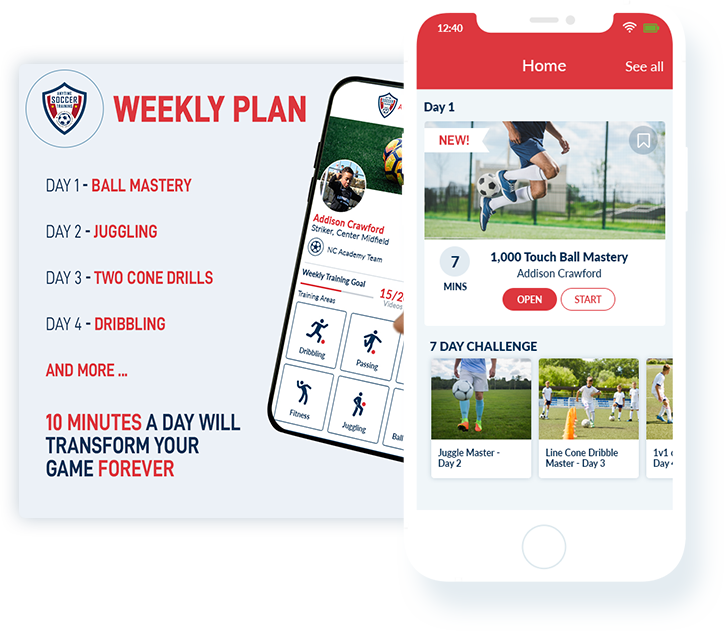
Whatever you spend on club, the biggest performance gains still happen at home — in the backyard, with a ball and a plan. Our library of 5,000+ training videos costs less than a dinner for two per year.
Try It Free for 7 Days →The Bottom Line
Club soccer is expensive in America because a significant segment of the population is willing to pay for professional-level, high-volume youth sports development — and has been willing to pay for it long before their kids have demonstrated they need it. That demand distorts the market, hollows out the volunteer-based community system, and makes the gap between those who can afford it and those who can't grow wider over time.
The supply side has real problems too — consolidation, field-space monopolies, lack of a genuine open pyramid. Those are worth fighting. But fixing them without addressing the cultural demand won't solve the pricing problem.
And comparing our system to European grassroots or academies misses the key detail: those systems are either built on free or near-free labor, or they only serve the elite. America has never fully accepted either of those constraints — and arguably shouldn't have to.
The path forward probably isn't a single policy fix. It's a combination: more structural competition on the supply side, renewed investment in community and rec systems, and a cultural conversation about what we're actually demanding — and whether it's serving our kids, or just our anxiety.
Interactive Tool
Club Soccer Budget Calculator
Registration, tournaments, gear, private training — see how quickly the real annual cost adds up for your family.
Try It Free →Whatever Club Costs —
Make the Most of It With Better Home Training
5,000+ training videos. Weekly plans by age and skill. The individual development work clubs don't have time for — done at home, on your schedule, for less than a dinner for two per year.
Start Free — No Credit Card Needed →
About the Author
Neil Crawford
Founder of Anytime Soccer Training and soccer dad to Adam and Matthew. He built the platform because he couldn't find one that worked for real families with real schedules — and because he made enough mistakes in his own backyard to fill a book.