Watch a youth game and count how often a player receives the ball with genuine space. It is rare. Almost every touch happens with a defender within two yards, in a corridor barely wider than the player is tall.
That is the game. And it is why tight-space dribbling is not an advanced extra to add later once the basics are done. It is the basic.
Why open-space drills flatter players
Cone slaloms with five yards between gates feel productive. They are also the easiest possible version of the skill: the player knows where the obstacle is, it does not move, and there is room to recover from a bad touch.
Tight-space work removes the margin. The ball has to stay within a foot, the touch has to be the right weight first time, and the head has to come up because the next problem arrives immediately.
A player who looks brilliant in a cone slalom and disappears in a match usually has one problem: every drill they do gives them more space than the game does.
Four drills that shrink the space
1. The one-yard box
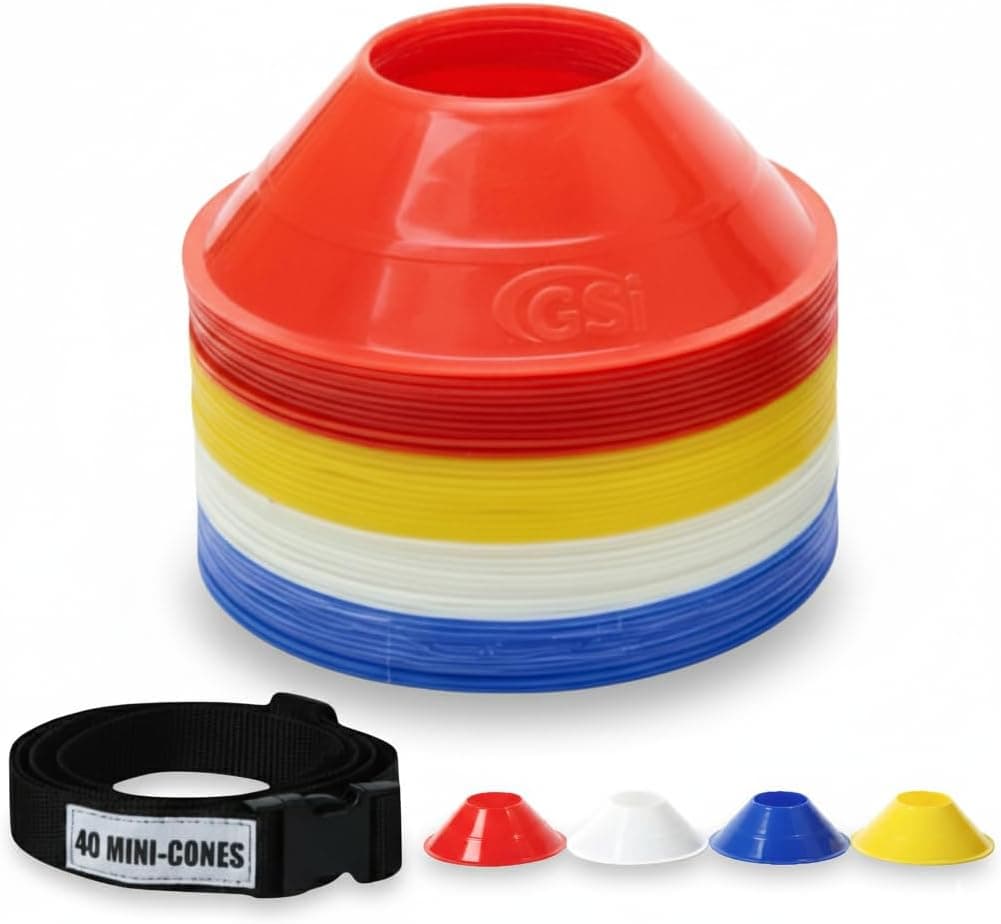
Four cones in a square, one yard per side. The player keeps the ball inside it using sole rolls, inside cuts and pull-backs.
- How to set it up: Four markers, one yard apart. Smaller than feels sensible.
- How long: 60 seconds on, 30 off, five rounds.
- What good looks like: The ball never leaves the box and the feet keep moving between touches.
- The usual mistake: Making the box bigger when it gets hard. The difficulty is the drill.
2. Wall pressure
Dribbling along a wall or fence, so one whole side is closed off. It forces the player onto their weaker foot and teaches shielding without needing a partner.
- How to set it up: Any wall. Dribble the length of it with the ball on the far foot.
- How long: 4 lengths each foot.
- What good looks like: Body between the wall and the ball, ball on the outside foot.
- The usual mistake: Drifting away from the wall to get comfortable.
3. Two-touch escape
From a standing start with a defender or cone right on top of them, the player has two touches to get out and away. Trains the decision, not just the technique.
- How to set it up: One cone directly in front of the ball, a yard away.
- How long: 10 escapes each side.
- What good looks like: First touch changes the angle, second touch accelerates.
- The usual mistake: Three or four touches. If it takes four, a defender has already taken the ball.
4. Traffic
Five cones scattered randomly in a ten-by-ten area. The player dribbles through, never repeating the same cone twice in a row.
- How to set it up: Scatter, do not line them up. Randomness is the point.
- How long: 90 seconds, three rounds.
- What good looks like: Head up choosing the next cone while the feet handle the ball.
- The usual mistake: Falling into a fixed route. Change the order every round.
How much, and how often
Ten to fifteen minutes, four times a week, beats an hour on a Sunday. Tight-space control is a motor pattern, and motor patterns are built by frequency, not duration.
A player who does twelve minutes four times a week does nearly three and a half hours a month of pure ball contact, without a single session that felt like a chore.
Train it, do not just read about it.
Every drill on this page is a follow-along video inside Anytime Soccer Training. Your player presses play, copies what they see, and the app keeps track of what they have done.
Start training free