Player Pathways • College Recruiting
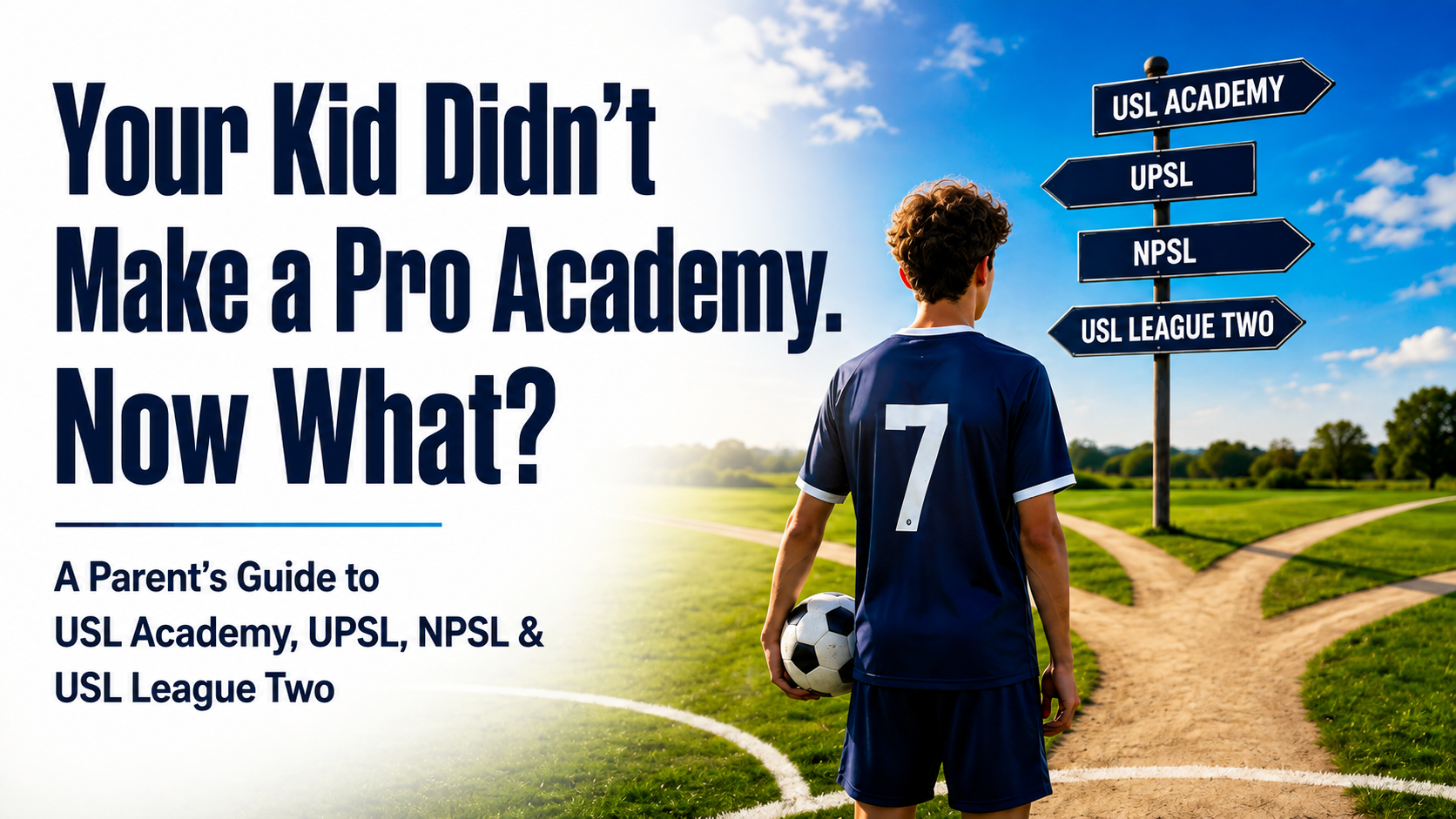
If your 16-year-old isn’t in an MLS academy, it can feel like the door to professional soccer just closed. It hasn’t. It just means you’re looking at a different set of doors — and most parents have no idea those doors even exist, let alone which one to knock on first, what it costs, when it starts, or what it does to college eligibility.
This guide covers the whole pathway, top to bottom: pro academies, MLS NEXT, USL Academy, UPSL, NPSL, and USL League Two. For each one you’ll get who plays, when the season runs, what it actually costs, the rules that affect your kid, and how it touches NCAA eligibility — plus a full FAQ for the questions that come up over and over in our community.
We’re starting at the top with the pro academies, because that’s where most families get the story wrong before they get anywhere else.
~150
MLS NEXT clubs — but only about 30 are MLS academies
90
USL Academy clubs in 2026, across 15 men’s divisions
900+
UPSL clubs, the largest pro-development league in North America
158
USL League Two teams, the biggest of the summer leagues
In This Guide
The Full Pathway at a Glance
Here’s the whole landscape on one screen — from the fully-funded pro academies at the top to the adult semi-pro leagues at the bottom. If you read nothing else, read this table.
| League | Level | Season | Cost to Player | Typical Age |
|---|---|---|---|---|
| MLS Academy | Pro academy, MLS-club run | Sep–Jul (school year) | Free, fully funded | U13–U19 |
| MLS NEXT (non-MLS club) | Top elite youth league | Sep–Jul (school year) | Full club fees + travel | U13–U19 |
| USL Academy | Pre-pro, club-affiliated | Spring–Summer (varies by club) | Free for selected players | U15–U20 |
| UPSL | 4th tier, adult semi-pro | Spring (Mar–Aug) & Fall (Sep–Feb) | Varies by club | 17–28 (avg. 22.5) |
| NPSL | 4th tier, amateur/semi-pro | Summer (May–Jul) | Varies by club | Mostly college-age+ |
| USL League Two | Pre-pro, college showcase | Summer (May–Aug) | Usually free/reimbursed | College-age (limited 23+) |
Swipe the table sideways on mobile to see every column.
Pro Academies: What Making It Actually Means
There are two genuinely professional academy systems for boys in this country: MLS club academies (roughly 30 of them, one per MLS club) and the academies run by USL Championship and USL League One clubs. Everything else calling itself an “academy” is a youth club using the word as marketing.
The distinction that matters isn’t the badge. It’s who pays. A real pro academy is funded by the professional club — no player fees, gear provided, travel covered, and for residency players often housing and schooling as well. If a program is charging your family thousands of dollars a year, it is not a pro academy, whatever the website says.
Why clubs fund it: the Homegrown rule
MLS academies exist for one commercial reason. Under the Homegrown Player rule, an MLS club can sign a player who came through its own academy directly to the first team — no draft, no competition from the other 29 clubs. The academy is how a club manufactures its own talent instead of buying it.
Below the first team sits MLS NEXT Pro, launched in 2022 as a third-division league of MLS reserve sides plus independent clubs. It’s where academy graduates get real professional minutes before — or instead of — breaking into the first team. That’s the full ladder: academy → MLS NEXT Pro → first team.
The Honest Timing Problem
Most academy places are filled at U13 to U15. By 16, a pro academy is generally not looking to develop a raw player — it’s looking to fill a specific positional gap with someone who can contribute immediately. It absolutely still happens. It just isn’t the volume game it was three years earlier, and no amount of emailing changes that.
Worth saying plainly: “free” is real, but the commitment isn’t free. Four to five sessions a week, significant travel, and for a lot of families either a brutal commute or an actual relocation. Before you chase it, be honest about whether your household can absorb that — and ask the hard questions of any program, pro or not.

Free Download
20 Questions for Every Club
The questions to ask before you commit to any program. Get it free →
Best for: players identified early who live within reach of an MLS or USL club, and whose families can absorb the schedule.
Inside an MLS Academy: Age Divisions and the Homegrown Rule
Once a family realizes MLS academies are genuinely free, two questions follow immediately: what ages do they even take? and what actually happens if my kid makes it? Almost nobody answers either one plainly, so here they are.
Part 1: how the age divisions work
An MLS academy doesn’t field one team. It fields a stack of them, one per age division, and those divisions line up with MLS NEXT’s structure: U13, U14, U15, U16, U17 and U19. A number of clubs also run a pre-academy or U12 program underneath as a feeder, which is where a lot of the real identification quietly happens.
Above U19 the ladder keeps going. That’s the part parents rarely see:
Feeder
Pre-academy
U12 & below
The Academy
U13 · U14 · U15
U16 · U17 · U19
The Bridge
MLS NEXT Pro
reserve side
The Goal
MLS
first team
Understanding that stack tells you where the doors actually are. U13 is the big intake year — that’s when a club builds a group. U15 is the second real window, when bodies change and clubs reassess. After that, movement is mostly replacement: someone leaves, gets injured, or ages out, and a club fills that exact hole. It’s not that a 16-year-old can’t get in. It’s that he’s competing for a vacancy rather than a place in a new group.
Two more structural things worth knowing. MLS NEXT groups clubs into regional divisions and conferences for the regular season, then brings the best together for a national playoff and for showcase events — and those showcases are where college and pro scouts actually congregate, far more than at any regular-season fixture. And clubs differ enormously on residency versus commuting: a handful relocate players and school them on site, while most academy players live at home and travel in. Ask which model a club runs before your family falls in love with the badge.
Part 2: what Homegrown actually means
This is the mechanism the whole system is built around, and it’s worth understanding before you commit years of your life to it.
Since 2008, an MLS club has been able to sign a player who came through its own academy directly to its first team — no SuperDraft, no other 29 clubs bidding. That’s the Homegrown Player rule, and it is the entire commercial reason a professional club pays for your kid’s coaching, kit and travel.
Homegrown territory
Each MLS club holds a defined geographic territory. A player from inside it who joins that academy generally becomes that club’s homegrown right. This is exactly why which club is nearest is not a trivial detail — geography assigns who can claim your son.
There's a time requirement
A player has to have been registered with the academy for a minimum period before he can be signed as a Homegrown. It is not a one-session arrangement, and the specifics move with the collective bargaining agreement — so confirm the current rule with the club, not with a forum post.
Clubs get a roster advantage
Homegrown signings carry roster and salary-budget benefits versus a comparable outside signing. That’s deliberate — MLS designed the incentive so clubs would rather develop a player than buy one.
And a resale line
Academy products sold on to European clubs have become a genuine revenue stream for MLS sides. Your son isn’t only a squad player in that model — he’s a potential asset, which cuts both ways.
The Fork In The Road
A Homegrown contract is a professional contract. Signing it ends NCAA eligibility permanently. That decision typically lands at 17 or 18, it has real money attached, and it is not reversible — so it deserves a conversation in your household long before anyone puts a pen in your son’s hand. Playing in the academy costs you nothing in eligibility terms. Signing does.
What to actually ask an MLS academy
- ✓Is my son inside your homegrown territory — and if not, what does that change?
- ✓How long must he be registered here before he could be signed as a Homegrown?
- ✓How many Homegrown players have you actually signed in the last five years — and how many of them got real minutes?
- ✓Do you run a residency program, and is my son expected to relocate?
- ✓What happens to a player you release at U16 — where do those boys typically land?
- ✓How does your college advising work for the majority who won’t sign?
That last question is the one that separates a serious program from a hopeful one. The overwhelming majority of academy players — including at MLS clubs — do not sign a professional contract. A program that has thought carefully about what happens to those boys is a program worth joining. One that hasn’t is selling you a lottery ticket. (Our 20 Questions for Every Club covers the rest of the list.)
MLS NEXT: Most of It Isn't MLS
This is the single most useful thing in this article, so here it is on its own line:
Not making an MLS academy does not mean MLS NEXT is closed to your kid. Roughly 150 clubs play in MLS NEXT. Only about 30 of them are MLS academies.
What it is: MLS NEXT launched in 2020, stepping into the hole left when U.S. Soccer shut down its Development Academy. It’s the top competitive youth platform in the country, running age groups from U13 through U19, and it’s operated by MLS — which is exactly why the name confuses people.
The MLS club academies play in it. So do well over a hundred independent elite clubs with no MLS affiliation whatsoever. Those independent clubs are where the overwhelming majority of MLS NEXT roster spots actually are — and they are reachable by a strong 16-year-old in a way an MLS academy usually isn’t.
Season: The academic year, roughly September through June or July, finishing at MLS NEXT Cup. That’s a genuine structural difference from everything else in this guide — MLS NEXT is the pathway that runs during school. UPSL, NPSL, and USL2 are built around the summer.
The catch is the invoice
MLS academies are free. The independent MLS NEXT clubs are emphatically not. They charge full competitive club fees, and once you add national travel to that number, MLS NEXT at a non-MLS club sits among the most expensive youth soccer in America. Same league, same badge, wildly different bill depending on which of the 150 clubs your kid signs with.
Free Ebook
Monopoly: Issues Facing US Youth Soccer
A candid look at why the bill keeps climbing. Get it free →
On eligibility: MLS NEXT is fully amateur. Playing in it does nothing to your NCAA status, and it is the most heavily scouted youth environment in the country by college coaches. For a college-track 16-year-old whose family can carry the cost, that combination is hard to beat anywhere on this list.
Best for: a technically ready 16-year-old chasing college recruiting, whose family can absorb full club fees plus national travel.
USL Academy: The Newest and Most Direct Pipeline
What it is: A club-run academy system launched in 2021, connecting directly into USL Championship, USL League One, and USL League Two clubs. For 2026, the league grew to 90 clubs across 15 men’s divisions — a big jump that included 28 new teams, five of them from USL’s professional ranks and nine from the pre-professional side.
Clubs to know: New Mexico United, Phoenix Rising FC, El Paso Locomotive FC, FC Tucson, Charlotte Eagles, Charlotte Independence, SC United Bantams, Greenville Triumph, and South Georgia Tormenta FC — largely mirroring USL’s professional footprint, plus a mix of independent academies like Barca Residency Academy competing alongside the club-affiliated programs.
Season: Timing varies by club and division rather than one fixed league-wide start date. As an example, Tormenta FC’s 2026 Southeast Division schedule ran an 8-game slate from late May through July against regional opponents like Charlotte Eagles and Charlotte Independence. Expect similar late-spring-through-summer windows across most divisions, but always confirm with the specific club.
The rules that actually affect your kid
One squad, not age groups
Instead of separate U15/U17/U20 teams like a traditional club academy, each USL Academy team is a single squad spanning U20 and below, with a required minimum number of U17-and-younger players to keep the age balance honest.
Five over-age players on gameday
Teams can dress up to five over-age players, which means a strong 16-year-old regularly competes alongside 19- and 20-year-olds instead of against his own birth year.
USL Academy Contracts
The standout feature. These let a player train — and even appear in matches — with a USL senior pro team while preserving college eligibility, provided they meet NCAA amateurism requirements.
Mandatory college advising
Every USL Academy club is required to run a college advisory program — USL openly acknowledges most players in the system will still go the college route.
What It Costs
Individual club academies — New Mexico United is the clearest public example — are advertised as free for selected players, covering coaching, competition, uniform, and travel/lodging/meals during academy play. This isn’t a league-wide mandate the way it is in MLS Next, so confirm with the specific club, but the flagship model is tuition-free.
One practical thing that trips families up when they move between these systems: registration and player cards. Different leagues, different governing bodies, different paperwork — and a missed card is a missed tournament.

Free Guide
Everything About Player Cards
Eligibility requirements, and how to avoid a missed tournament. Get it free →
Best for: players already performing at a high level who live in or near a USL market — and the strongest free option on this list.
UPSL: The Biggest Net, But Not a Youth Development League
What it is: UPSL is an American for-profit adult soccer league founded in 2011 in Santa Ana, California. It has grown into the largest pro-development league in North America, with 900+ men’s and women’s clubs, and is widely considered the unofficial 4th tier of U.S. Soccer — sitting just below MLS, USL Championship, and USL League One.
Clubs to know (2025–26): Deportivo Rose City (2026 Spring National Champion), Miami United FC, New York Renegades FC (2025 Fall National Champion), and California United FC II — one of the winningest clubs in league history. UPSL has also become a notable launchpad for international talent; Yan Diomande, a former UPSL National Finals MVP, went on to sign with Real Madrid after a stint at RB Leipzig — the kind of story UPSL leans on heavily in its marketing.
The Calendar Difference
UPSL runs two seasons a year: Spring starts in March and runs to national playoffs in late July/early August; Fall starts in September and runs to national playoffs in early February. That year-round structure is UPSL’s biggest practical difference from NPSL and USL League Two, which are essentially summer-only.
The rules that actually affect your kid
- ●No official minimum player age — but UPSL is fundamentally an adult league. Average participant age is 22.5. Because minors on a roster trigger SafeSport child-safety training and background-check requirements plus locker-room separation rules, many clubs simply keep rosters 18+.
- ●Each club is independently owned and operated — so pay structures, coaching quality, and how seriously a club treats development vary enormously from one club to the next, even inside the same conference.
- ●Internal promotion and relegation exists between the Premier Division and Division I in most conferences, and some regions (historically SoCal and Colorado) run an additional Championship Division tier below Premier.
- ●The Premier Division alone had 344 clubs competing for 32 national playoff spots in Spring 2026. This is a genuinely large, competitive ecosystem — not a niche one.
If your player is in the gap between youth club and adult soccer, guest playing is the underrated way to keep getting competitive minutes while you sort the longer-term plan out.

Free Ebook
Everything About Guest Playing
How to find minutes when your player is between teams. Get it free →
Free Community
Guest Player Opportunities
Find and post guest playing spots. Join free →
Best for: players 17+ outside the college or pro-academy track who need a competitive, semi-structured environment to keep developing and stay visible. Less ideal as a primary environment for a 16-year-old still building toward that stage.
NPSL: The Amateur Alternative
What it is: The National Premier Soccer League is UPSL’s closest direct competitor, occupying the same unofficial 4th tier. For 2026, 55 teams compete across 8 conferences.
Season: The 2026 regular season ran May 2 – July 4 — a tighter, summer-focused window compared to UPSL’s year-round two-season model.
- ●NPSL is explicitly structured to accommodate college players in the off-season, similar in spirit to USL League Two — though its amateurism rules have historically been looser and more club-dependent than USL2’s.
- ●The league has seen real churn recently — several clubs left NPSL in 2026 for USL League Two, NISA, or newer regional alternatives like the Florida Champions League and The League for Clubs (a 2024-founded amateur league with backing from figures like Chicago Fire GM Peter Wilt).
- ●Because it’s built around a shorter summer window, it lines up more naturally with a college player’s off-season than with a 16-year-old’s academic-year schedule.

Free Ebook
The Parent Trainer's Playbook
20 unconventional tips from one soccer dad's journey. Get it free →
Best for: college-age or college-track players wanting a summer competitive outlet — and as a secondary option to USL League Two in regions where NPSL clubs are stronger locally.
USL League Two: The College Showcase League
What it is: The oldest of the fourth-tier leagues, operating since 1995 (formerly the PDL). For 2026 it’s the largest of the summer leagues by far — 158 teams across 20 divisions in Central, Eastern, Southern, and Western conferences.
Season: The 2026 regular season ran May 3 – July 12, with playoffs July 13 – August 1 — almost identical timing to NPSL, since both exist to fill the same college off-season window.
- ●USL2 was built from day one to protect NCAA eligibility. It functions as a “pre-professional” rather than professional league specifically so college players can compete without burning their amateur status.
- ●Roster rules limit teams to eight players over the age of 23, keeping the league genuinely youth- and college-age-weighted rather than drifting into an adult men’s league the way UPSL can.
- ●Players may be reimbursed for expenses without it counting against amateur status, but the league does not pay salaries to its predominantly amateur player pool.
The summer leagues all run May through July for the same reason — which means the months before May are when a player either arrives ready or arrives behind. That window is entirely in your family’s control.

Best for: college-committed or college-track players — particularly those already on a college roster — who want a structured, NCAA-safe summer season with strong scouting visibility.
How This Affects College (NCAA) Eligibility
This is the question that trips up more families than anything else, so let’s be precise.
The Core Rule
A player loses amateur status if they use their athletic skill for pay, sign any kind of professional contract, accept a promise of future pay, or compete on a team that declares itself professional — regardless of whether the player personally received money.
Safe
MLS NEXT & Pro Academies
Fully amateur, and the most heavily scouted youth environment in the country. Playing here costs you nothing in eligibility terms.
Safest
USL League Two
Purpose-built around the amateurism rule. It’s why so many current NCAA athletes play there every summer.
Check First
NPSL
Same spirit, more variation. The protections are real but historically less airtight than USL2’s — confirm a specific club’s structure before committing.
Real Diligence
UPSL
Pay decisions are left to each independently-owned club. If a club pays players — even informally — participating can jeopardize amateur status even for a player who received nothing.
On top of the pay question, NCAA rules generally block a student-athlete from competing for an outside team during their college sport’s declared season — so timing matters as much as pay structure. Always confirm directly with a specific UPSL club how they operate before a player who wants to preserve college eligibility joins.
What Actually Ends It
Signing a Homegrown contract with an MLS club, or an MLS NEXT Pro contract, is signing a professional contract. That ends NCAA eligibility, full stop — and it’s a genuine fork in the road, not a technicality. Note the distinction: MLS clubs can field academy players in MLS NEXT Pro matches as amateurs without signing them. It’s the signature that changes everything, not the appearance.
The Interesting Middle Ground
USL Academy Contracts explicitly let a player train and even appear in matches with a USL senior professional team while preserving college eligibility, as long as the arrangement stays inside what the NCAA permits (no more than actual and necessary expenses, no employment-style pay). It’s one of the more parent-friendly innovations in the current landscape — real professional-environment exposure without forcing an early, irreversible choice between college and pro.
One more wrinkle worth knowing: the NCAA’s “May 1 exception” generally prohibits college soccer players from competing outside their school before May 1 of a given year — which is part of why the NPSL, USL2, and UPSL summer seasons all cluster in that May–July window. They’re built around that rule, not in spite of it.
Parent FAQ
We didn’t get into an MLS academy. Is MLS NEXT still possible?
Yes — and this is the misunderstanding that costs families the most. Roughly 150 clubs play in MLS NEXT and only about 30 are MLS academies. The other ~120 are independent elite clubs that recruit openly. Missing an MLS academy closes one door out of roughly 150.
Is MLS NEXT free?
Only if it’s an MLS club academy. Those are fully funded. The independent MLS NEXT clubs charge full competitive club fees plus national travel, which puts them among the most expensive youth soccer in the country. Same league, completely different bill.
Can a 16-year-old still get into a pro academy?
It happens, but understand the odds. Most academy places are filled at U13–U15, and by 16 a club is typically filling a specific positional gap rather than developing a raw player. Treat it as a possible outcome of playing well somewhere visible, not as a plan in itself.
My 16-year-old isn’t in a pro academy. What should we actually do first?
Be honest about physical and tactical readiness for adult or near-adult competition. If you can carry the cost, a non-MLS MLS NEXT club is the best-scouted room in the country. If you can’t and you’re near a USL market, USL Academy is the strongest free option and preserves every future choice. If neither fits, keep building in a strong club environment for another year before pushing into UPSL or NPSL.
Can a 16-year-old play in UPSL?
Technically yes — there’s no official minimum age — but it’s uncommon. UPSL is an adult league (average age 22.5), and many clubs keep rosters 18+ specifically to avoid the SafeSport and liability complications that come with minors on an adult roster.
Is UPSL the best league for a 16-year-old trying to go pro outside an academy?
No single league is definitively “best.” UPSL is genuinely valuable, but usually a year or two later than most parents assume — it’s a competitive outlet for players 17+, not a youth development curriculum.
Does playing UPSL kill college eligibility?
Not automatically — but it can, depending entirely on how the specific club operates. Because clubs are independently owned and UPSL doesn’t mandate amateur status league-wide, always verify with the club directly before a college-track player joins.
What actually ends NCAA eligibility?
Signing a professional contract — a Homegrown deal with an MLS club, an MLS NEXT Pro contract, or any paid arrangement with a club that declares itself professional. Playing MLS NEXT, a pro academy, USL Academy, or USL League Two does not.
What’s the actual difference between NPSL and USL League Two?
Both run almost the same summer window (roughly May–July) and both exist mainly to give college players a competitive off-season outlet. USL2 is larger, older, and has stricter built-in NCAA protections; NPSL is a comparable but somewhat smaller and more club-dependent alternative — sometimes the better local option depending on which league has stronger clubs in your region.
Is USL Academy actually free?
The flagship examples (like New Mexico United) are free for selected players, covering coaching, competition, uniforms, and travel. It’s not a league-wide guarantee the way it is with MLS academies, so confirm funding directly with the specific club.
When do these seasons actually start?
- Pro academies & MLS NEXT: the school year, roughly September–July
- USL Academy: varies by club, generally late spring through summer
- UPSL: two seasons — Spring (March–August) and Fall (September–February)
- NPSL: May–July
- USL League Two: May–August (regular season through playoffs)
What if my player wants to preserve college eligibility and get pro-level exposure?
Look hard at a USL Academy Contract if it’s geographically available. It’s currently the clearest pathway on this list explicitly designed to let a player train and play with a senior professional team while keeping NCAA eligibility fully intact.
Free Community
Still have a question we didn't cover?
Ask it in our parent group — a safe space for exactly this. Join free →
The Bottom Line
Not making an MLS academy closes exactly one door. Here’s the honest ranking of what’s left.
If you can carry the cost, a non-MLS MLS NEXT club is the strongest college-recruiting environment in the country, and it’s open to a strong 16-year-old in a way an MLS academy usually isn’t. If you can’t, USL Academy — where geographically available — is the clearest, most direct, and most cost-free pathway toward a professional opportunity while preserving every future option.
UPSL is a real and valuable tool, but it’s an adult competitive league that becomes most useful a year or two later than most parents assume, and it demands real diligence around pay structure if college eligibility matters to your family. NPSL and USL League Two are the safer, NCAA-protected summer options once your player is closer to college age.
“The families who navigate this well aren’t the ones who found the ‘best’ league. They’re the ones who got honest about where their kid actually is right now, checked the eligibility fine print before committing, and picked the environment that matched — not the one with the most buzz in the group chat.”
And whichever door your family ends up knocking on, the thing that decides whether it opens is the same one it’s always been: what your player does on the ball between now and then. Every league on this list is scouting for the same thing.

Free Ebook
The Most Important Skill Never Taught
A simple tip that changes how your child sees the game. Get it free →

Free Guide
Must-Have Guide to In-Home Training
Everything you need to start training at home effectively. Get it free →
Every pathway on this list rewards the same thing: a player who can handle the ball.
5,000+ follow-along training videos. Build the technical base that makes any of these doors a real option. ⚽
Start Training Free →Gear We Recommend
A player chasing any of these pathways needs somewhere to get their reps in between sessions. This is the equipment we actually use and recommend — the full list lives on our Our Picks page.
⚽ Essential Training Gear



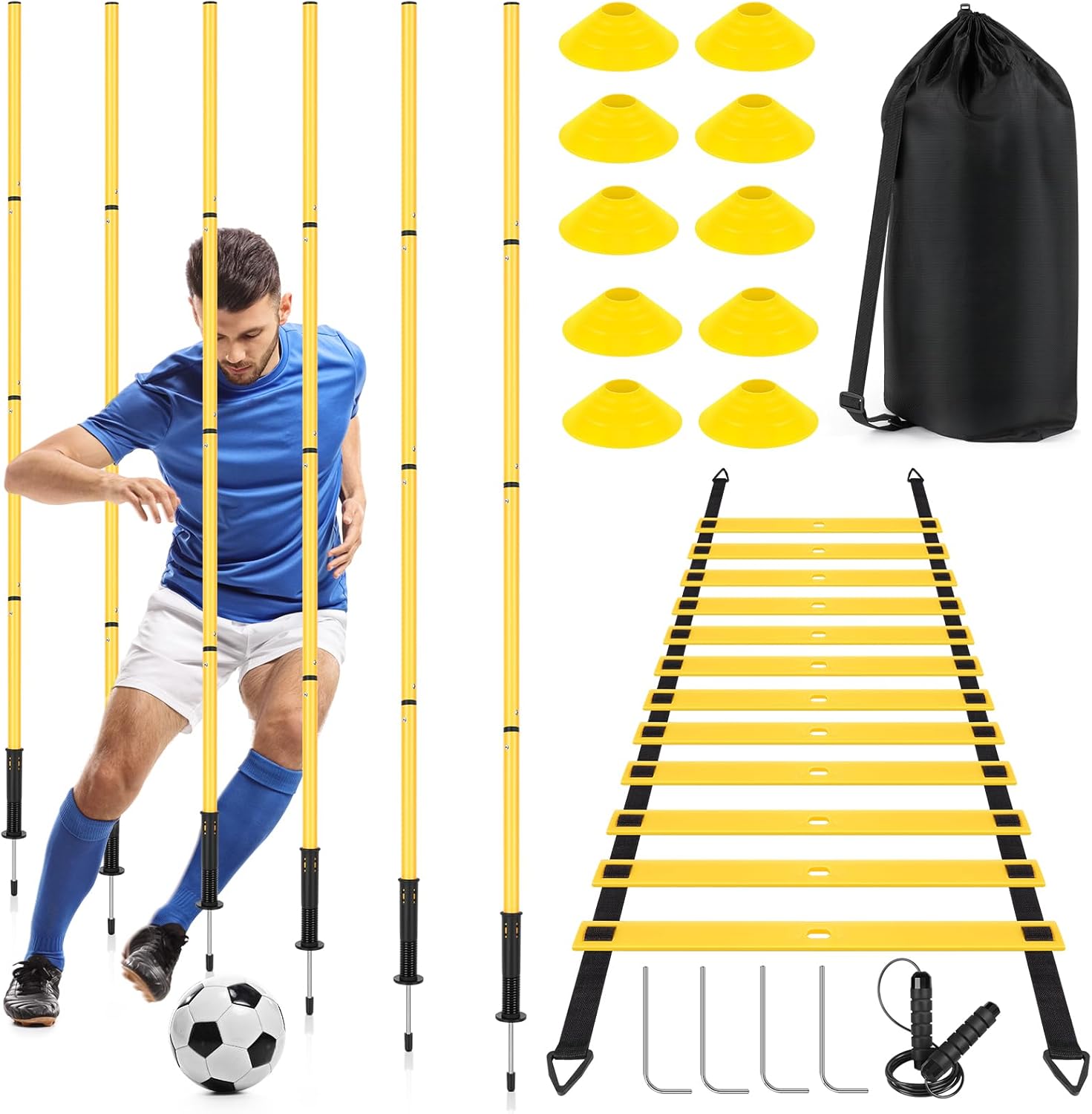
🎯 Soccer Rebounders



Disclosure: As an Amazon Associate and affiliate partner, we earn from qualifying purchases. This helps support our site at no extra cost to you.
Have questions about where your player fits in this landscape? This is exactly the kind of thing we dig into on The Inside Scoop — subscribe for more breakdowns of the pathways, economics, and decisions that actually shape a youth soccer career.