The Inside Scoop · Episode 6
By Neil Crawford · The Inside Scoop, Episode 6 · Nov 24, 2026
The simplest way to give your child more touches on the ball is to bookend their regular practice: fifteen minutes of light ball work before training, and fifteen minutes after if they are not tired.
In this post
That is the first of what I call the secrets of ball mastery, and it is the tip I want to share in this article. I am working on an ebook called The Five Secrets of Ball Mastery. There will actually be a lot more than five, but I am sticking with five for the ebook, and over the next few episodes of The Inside Scoop I am dropping them one at a time so you can listen, implement and move on to the next.
Before I give you the tip, though, I want to define who it is for. These secrets are written for the parent trainer, and I count myself as one. If you do not believe the way a parent trainer believes, the tips will probably not be relevant to you. So let me explain what I mean.
What is a parent trainer?
Key point
A parent trainer is defined by what they believe and by the actions they take every day to support those beliefs, not by how they look or what they say.
If I looked at a hundred parents in a room, I could not tell you which ones are parent trainers. Appearance does not reveal it. Words do not either, because many people say the same things, and saying something does not make you one. What does is a belief system, plus the daily actions that back it up.
I think parent trainers share at least two beliefs.
- Deliberate practice works. They have seen it improve their own lives and other people's lives, and it does not matter what the person is trying to do. If you practice painting fifteen minutes a day, you will become a better painter. If you practice your scales for fifteen minutes a day, you will become a better musician. Soccer is just one place to apply the same idea.
- Your child will not reach their full potential in any area if you outsource 100 percent of it. The parent trainer needs a piece of the development, even a small one.
You cannot outsource it all
Key point
Think of your child's development as a pie chart. The coach, the tutor and the parent each get a slice, and the parent trainer believes they need some slice, however small.
School is the easiest example. Most parents send their children to school, a huge slice of that pie, and the teachers do a great job delivering content at the right level. A parent trainer is not trying to take the teacher's place. If they have the means, they may add a private tutor or a small-group tutor who works on the child's specific needs, and the parent trainer fully supports that.
But the parent trainer also understands that a child will never reach their full potential academically if the only time they study is with the teacher or the tutor. The child has to study on their own. And no normal young child comes home and studies on their own consistently enough to get there. They need encouragement and a system, and that is where the parent steps in.
Soccer works the same way. My own son plays on a team that does the bulk of his training, and every week or two he goes to a small-group clinic that focuses on technical work. I am happy with that. He is around his friends, and one reason we chose it is that kids in the States do not get enough free play, so a little technical training is not going to hurt him. He also gets specific instruction he would not get with the team. But if I want him to reach his potential, he needs to do a little on his own, and most parent trainers know a very young child will not do that by themselves.
"Why not just let them play?"
There is another school of thought: just be the parent, play one-on-one, enjoy it and let them have fun. A parent trainer's answer is that you can do both.
Because a parent trainer sees the power of deliberate practice, they believe that if you manage it properly, you can have fun with your child and enjoy the game together, the same way you enjoy reading bedtime stories. At the same time, out of the 24 hours you have with them, you can introduce twenty or thirty minutes of deliberate practice. That gives your child more confidence and skill, and it means the coach, the trainer and the tutor inherit a child who is confident, skillful and ready, which only improves their experience in those settings.
I will be blunt about the other side of it. If we just wanted to watch them play, we would go to a playground. We signed them up for competitive sports for a reason: so they can have fun and be fulfilled, and learn some valuable life lessons along the way.
Getting it from all sides
Key point
Parent trainers get pushback from everywhere, and the hardest part is that a young child often does not understand what you are trying to do.
Coaches call us crazy. Other parents tell us we are trying to create the next Messi and living vicariously through our children. Sometimes even a spouse does not agree with what you are doing. And in most cases, the child is too young to understand it at first.
The advice online does not help much either. A lot of what I find on social media and YouTube is either too general to do anything with or too simplistic to apply. It is not actionable, or it describes a utopia that does not match real life. Parent trainers need specific, actionable steps they can use and pass along, steps that help a child reach their potential in a positive way and not a negative one.
There is also a real dilemma. We want to help our young children train and get better, and we will not outsource 100 percent of that. But we know there is a delicate parent-child relationship that we have to navigate properly, or we could do more harm than good. We also have to find the right balance between training and taking the fun away.
That is why I created Anytime Soccer Training. Not necessarily for the videos, which are a tool I hope some of you will use. I created it to share my experience and help you avoid some of the mistakes I made on this journey.
Secret #1: bookend your child's training
Key point
Bookend your child's regular training with a short, easy ball-mastery session before it and, if they are not tired, another after it.
Here is how it works in my house. My child typically practices three days a week and has a game on the weekend. Very early on I told my son: you are already geared up for practice, so we are going to get to the field, or step out into the yard, and do our own fifteen minutes before training. If it is summer and still light out, and he is not tired, we do another fifteen minutes of very light juggling after training. That adds up to thirty extra minutes of ball mastery on a training day.
If I am running late, it might only be five or ten minutes. It is normally a short amount of time. Because it is light, he is fully recovered by the time we get in the car, so it does not wear him out. It simply adds touches before he trains.

Gear that helps
Adidas MLS Training Soccer Ball
A durable size 4 or 5 ball for every session at home.
See it on Amazon →Why not use his off days?
I want to preserve his mental side as well as his physical side. Mentally, he is already geared up to go to practice or to a game. We are following the exact same routine. I am effectively telling him that we are starting his practice fifteen minutes before the other kids start. His off day stays his off day.
What to say to your child
I talk to my son something like this. The only thing that may feel odd is that Daddy is delivering this training. Normally, as you get older, either you do it yourself or a trainer does it with you. But here is my promise: these routines will be something you already know. This is not the time to teach you new things. We are just getting your ball mastery, juggling or combos and figure-eights in quickly, and it will not be too strenuous.
Keep the routine simple
Use any resources you like. I use Anytime Soccer Training videos, but you do not need me. The product was not even out when I started doing this. What matters is that the routines are easy for your child to understand. You are not trying to teach, you are getting repetitions in. Keep a set routine, though you can shift it around. In fifteen minutes I can get around 1,000 touches in before we hit the field, which means he is guaranteed more touches at that practice than probably the whole team combined.
Gear that helps
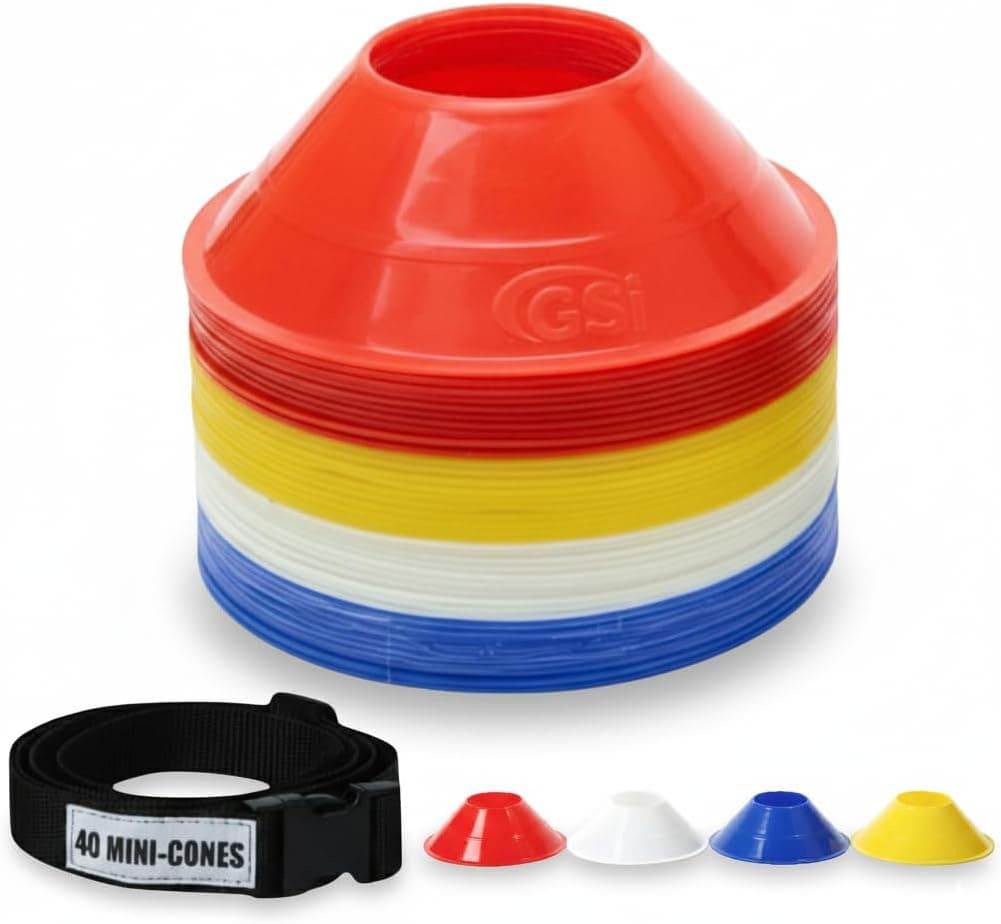
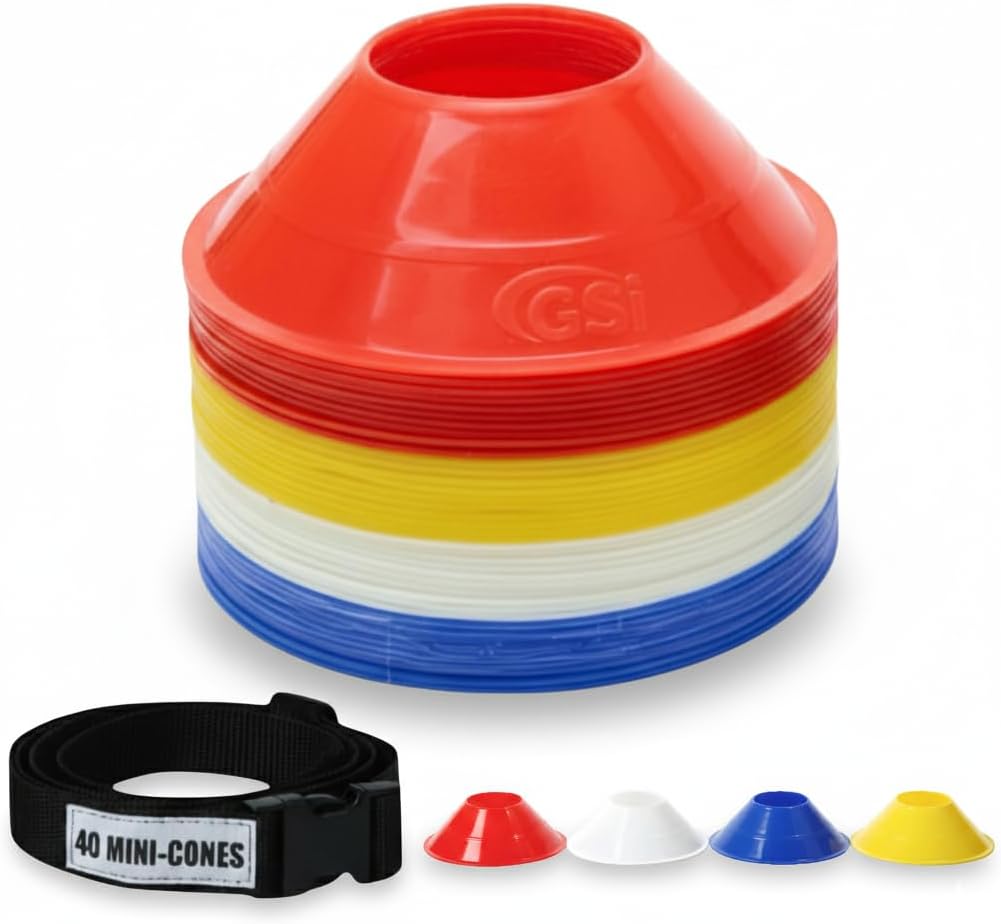
Disc Training Cones (Set of 40)
Enough for boxes, weave courses and anything else you set up in the backyard.
See it on Amazon →What it adds up to
Key point
Fifteen minutes before practice, three or four days a week, adds more than 40 hours of extra training over a season, before you do anything else.
That is my math, and it ignores the post-practice sessions entirely. Those 40 hours cost your child almost nothing in energy or time, and their cumulative impact is huge when you start comparing his ability on the ball with his peers'. It has been a big success for my boys, because it gets the touches in without using their off day. I want their off day to be their off day, but I know I need to squeeze extra touches in while we are already at the field, because kids in America do not get enough free play.
It is the same principle as reading. When my boys read on the way to school, they get extra reading in without adding a single trip. Bookending practice does for soccer what that does for reading.
One side effect: your child arrives at the game warmed up and ready to roll.
I love my private trainers, and I am one myself. But unless a private trainer is going to follow you after work and do a fifteen-minute juggling routine with your child before they hit the field, your child will not reach their full potential unless you do it.
The Part You Control
Extra Training at Home, Without Guessing What to Do
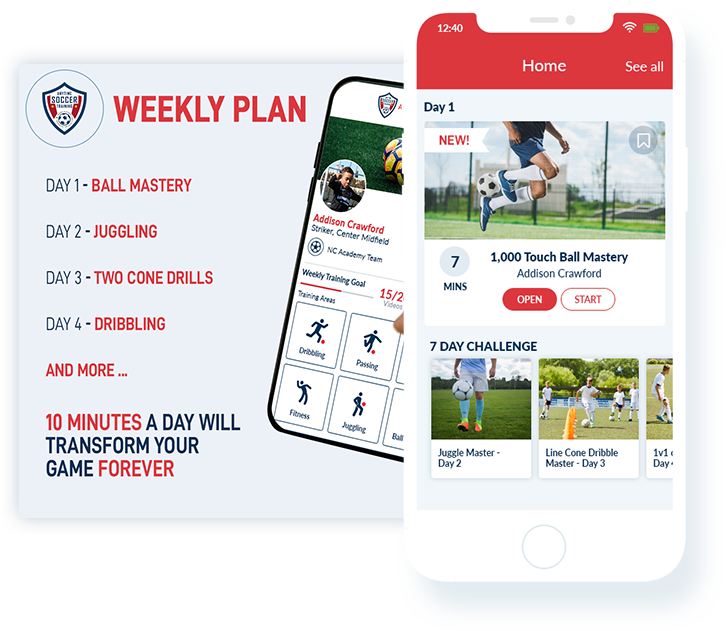
Whatever system your child plays in, the extra work usually falls to the family. Anytime Soccer Training gives you 5,000+ follow-along videos (ball mastery, juggling, first touch and more) in a set order, so you always know what to do next.
Try It Free for 7 Days →What this does and does not mean
Key point
Asking your child to arrive ten or fifteen minutes early to get extra touches in does not mean you want them to be the next Messi, it does not mean you are stealing their joy, and it does not mean you are hurting the parent-child relationship. Do not let anyone tell you otherwise. Teaching your child to train smart as well as hard is a good thing.
I will add a harder note. If your child is in one of these so-called competitive programs and refuses to arrive ten or fifteen minutes early to work on their craft, you may need to reevaluate whether competitive soccer is right for your family. There are too many ways to enjoy soccer to force it. I have a younger son who may or may not play competitively, and that is fine. But if you are going to be in a competitive environment, take the extra time to gain the competitive advantage, both physically and mentally.
Try it this week
Key point
Pick one practice this week and try this routine.
- Choose a short, familiar routine. Juggling, ball mastery or combos your child already knows. You are collecting repetitions, not teaching.
- Arrive ten to fifteen minutes early to the field, or step into the yard before you leave home. Keep it light enough that your child is not tired.
- Add a short cooldown after practice if there is daylight and your child has energy. Five minutes counts.
- Leave off days alone. Your child is already mentally geared up on practice and game days, so use those.
- Say less than you think you need to. Remind your child the routine is familiar and not a new lesson.

Gear that helps
Bluetooth Speaker
Play the follow-along video or interval timer out loud in the yard.
See it on Amazon →I would love to see parents out there doing this fifteen minutes before practice. If you do, share a video with me. And if you want to be on the show, or just want to tell me I am crazy, I would love to hear from you.
I am passionate about helping parents help their children. I want Anytime Soccer Training to be successful, but at the end of the day, I really want your child to be successful. Let's get better together.
Free ball mastery and juggling videos are available at anytime-soccer.com.
As an Amazon Associate, Anytime Soccer Training earns from qualifying purchases. Gear links in this post are affiliate links; they cost you nothing extra.