
Age-Based Training What Changes from U6 to U12
March 15, 2026
Age-Based Training: What Changes from U6 to U12
One of the most common questions I get from soccer parents is, "What should my child be working on at their age?" It is a great question because the answer changes significantly as children grow. What is appropriate and effective for a six-year-old is very different from what works for a twelve-year-old, and getting this right can mean the difference between optimal development and wasted time.
I have been through this progression with both of my sons, and I have seen firsthand how training needs evolve with each age group. Here is a comprehensive breakdown of how training should change from U6 all the way through U12, with specific recommendations for each stage.
U6 (Ages 4-5): The Discovery Phase
At U6, soccer is about discovery and fun. These tiny players are still learning how to coordinate their bodies, and their understanding of team sports is essentially nonexistent. And that is completely fine.
Training focus:
- General motor development: running, jumping, balancing, hopping
- Introduction to the ball through free play and simple games
- No structured drills or technique instruction
- Activities should change every three to five minutes to match attention spans
- Everything should feel like play, not practice
Game format: Three-on-three or four-on-four with no goalkeepers. Small fields. Short games of ten to fifteen minutes.
Home training: At this age, home training means playing with a ball in the yard. No structured sessions are needed. Just make a soccer ball available and let your child explore.
What parents should focus on: Is my child having fun? Are they developing a positive relationship with physical activity? That is all that matters at U6.
U7-U8 (Ages 6-7): The Foundation Phase
This is where the golden age of motor learning begins, and the foundation of technical development can start to be laid. Children at this age have better coordination, slightly longer attention spans, and are beginning to understand basic concepts of games with rules.
Training focus:
- Ball mastery basics: sole rolls, tick tocks, toe taps, inside touches
- Introduction to dribbling and close control
- Fun challenges and games that incorporate the ball
- Beginning to develop coordination and agility through ladder work, hopping, and skipping
- Both feet should be used from the very beginning
Game format: Four-on-four or five-on-five. Still small fields. Short halves of twelve to fifteen minutes.
Home training: This is the ideal age to start short, structured home training sessions. Five to ten minutes of follow-along ball mastery work is perfect. Anytime Soccer Training has programs designed specifically for this age group that keep sessions fun and appropriately challenging.
Key development at this age: The primary goal is to build comfort and confidence with the ball. A child who finishes the U8 age group with solid ball mastery fundamentals is well-positioned for rapid development in the years ahead.
U9-U10 (Ages 8-9): The Skill Explosion Phase
This is one of the most exciting phases of youth soccer development. Children at this age are at the peak of the golden age of motor learning, with attention spans long enough for more structured training and coordination levels that allow for real skill acquisition. Skills that are introduced during this phase can be learned remarkably quickly.
Training focus:
- Intensive ball mastery: more complex patterns and increasing speed
- First touch development: receiving ground passes and directing the ball
- Dribbling with purpose: learning to dribble to beat defenders, not just to move the ball
- Introduction to basic moves and turns: inside cut, outside cut, pull-back, Cruyff turn
- Passing accuracy with the inside of the foot
- Basic shooting technique
- Weak foot development becomes a priority
Game format: Seven-on-seven or eight-on-eight. Medium-sized fields. Proper halves of twenty to twenty-five minutes.
Home training: Daily fifteen-minute sessions become the standard. This is the age where consistent daily practice produces the most dramatic results because the brain is so receptive to learning new motor skills. A structured program that progresses through ball mastery, first touch, dribbling, and moves is ideal.
Key development at this age: The child should be developing into a technically comfortable player who is confident on the ball and can execute fundamental skills with increasing consistency. This is also when you start to see the separation between kids who train at home and those who do not.
U11-U12 (Ages 10-11): The Integration Phase
At U11-U12, the focus begins to shift from pure skill acquisition to skill application. Players at this age are ready to start integrating their technical skills into more game-realistic contexts, and tactical awareness begins to develop.
Training focus:
- Continued technical refinement with increasing speed and pressure
- Applying skills in game-like situations: receiving under pressure, dribbling in tight spaces, passing to moving targets
- Introduction to basic tactical concepts: width, depth, support, pressing
- Position-specific awareness begins (though full specialization should wait)
- One-on-one defending and attacking
- Combination play: wall passes, overlaps, give-and-go
- Heading introduction (where age-appropriate guidelines permit)
- Set pieces basics
Game format: Nine-on-nine or eleven-on-eleven. Larger fields. Full-length halves of twenty-five to thirty minutes.
Home training: Fifteen to twenty minutes daily. Sessions should include a mix of ball mastery warm-up, skill-specific work, and game-realistic challenges. At this age, children can start to self-direct their training more, choosing areas they want to work on based on their own assessment of their game.
Key development at this age: The player should be transitioning from someone who can perform skills in isolation to someone who can apply those skills under game pressure. Decision making starts to become important: knowing when to dribble versus pass, when to go forward versus play safe.
How Training Volume Should Change
As children progress through these age groups, the total training volume should gradually increase:
- U6: One to two organized sessions per week, thirty to forty-five minutes each. Plus informal play.
- U7-U8: Two organized sessions per week, forty-five to sixty minutes each. Plus five to ten minutes of home training three to five days per week.
- U9-U10: Two to three organized sessions per week, sixty to seventy-five minutes each. Plus fifteen minutes of home training daily.
- U11-U12: Three organized sessions per week, seventy-five to ninety minutes each. Plus fifteen to twenty minutes of home training daily.
Notice that even at U12, the total weekly soccer commitment is manageable. We are not talking about training five hours a day. We are talking about a reasonable increase in volume and intensity that matches the child's growing capacity for focused work.
The Critical Shift That Happens Around U10
There is a critical shift that happens around the U10 age group that every parent should be aware of. This is the age where individual skill level starts to meaningfully impact team performance and where the gap between players who train at home and those who do not becomes glaringly obvious.
At U6 and U8, games are chaotic and skill differences are masked by the nature of the small-sided format. Everyone is chasing the ball in a pack, and individual technical ability does not always stand out. But at U10 and beyond, the game starts to open up. Players who can receive the ball cleanly, dribble past defenders, and make accurate passes start to dominate. Players who cannot do these things start to get left behind.
This is why the U7-U10 window is so critical for home training. The skills developed during this period are what allow a player to thrive when the game becomes more structured and demanding. A player who enters U10 without solid ball mastery and first touch skills will struggle to catch up, while a player who has been training consistently at home will be positioned to excel.
Multi-Sport Participation Across Age Groups
I want to reiterate the importance of multi-sport participation across all of these age groups:
- U6: Multiple sports and physical activities are essential. No specialization at all.
- U8: Multiple sports still strongly recommended. Soccer can be a primary interest but should not be the only sport.
- U10: Multiple sports still beneficial. Soccer training volume increases but should not crowd out other activities.
- U12: Gradual increase in soccer focus is appropriate if the child desires it, but maintaining at least one other sport or physical activity is still recommended.
The athletic skills developed in other sports, balance from gymnastics, hand-eye coordination from basketball, speed from track, spatial awareness from basketball, all transfer to and enhance soccer performance. Do not sacrifice athletic breadth for soccer-specific volume at young ages.
Adapting to Individual Development
While these age-group guidelines provide a useful framework, it is important to remember that every child develops at their own pace. Some children are physically and cognitively ready for more advanced training earlier than their peers. Others need more time with foundational skills before progressing.
Use your child's age group as a starting point, but pay attention to their individual readiness. Signs that your child is ready for more advanced training include:
- They are consistently performing current exercises with ease and minimal errors
- They are bored or unchallenged by the current level of training
- They are asking for more complex skills or activities
- They can maintain focus and effort through the full training session
Signs that you might be pushing too hard for their developmental stage include:
- Consistent frustration and inability to perform the exercises
- Declining interest or motivation
- Physical signs of overtraining like fatigue or persistent soreness
- Emotional regression like increased irritability or anxiety around soccer
Anytime Soccer Training handles this well by offering programs at different difficulty levels that your child can progress through at their own pace. If a program is too easy, they can move to the next level. If it is too challenging, they can stay at the current level until they are ready. This self-pacing ensures that every child is working at the edge of their ability, which is the sweet spot for optimal development.
The Bottom Line
Understanding how training evolves from U6 to U12 gives you a roadmap for your child's development. The key principles are:
- Start with play and fun at U6, gradually introduce structure through U8 and U10
- Use the golden age of motor learning (U7-U12) to build a strong technical foundation
- Increase training volume and complexity gradually, matching your child's developmental readiness
- Prioritize ball mastery and individual skills before tactical concepts
- Maintain multi-sport participation throughout
- Use daily home training to maximize the developmental windows that team training alone cannot fully exploit
Each age group is a building block for the next. Get the foundation right at U6 and U8, maximize skill development at U10, and integrate those skills into game performance at U12. That is the progression, and it works every time when followed with consistency and patience.
Gear we use for this
The kit our own players train with at home.

Size One Soccer Ball
View on Amazon →
Adidas MLS Training Soccer Ball
View on Amazon →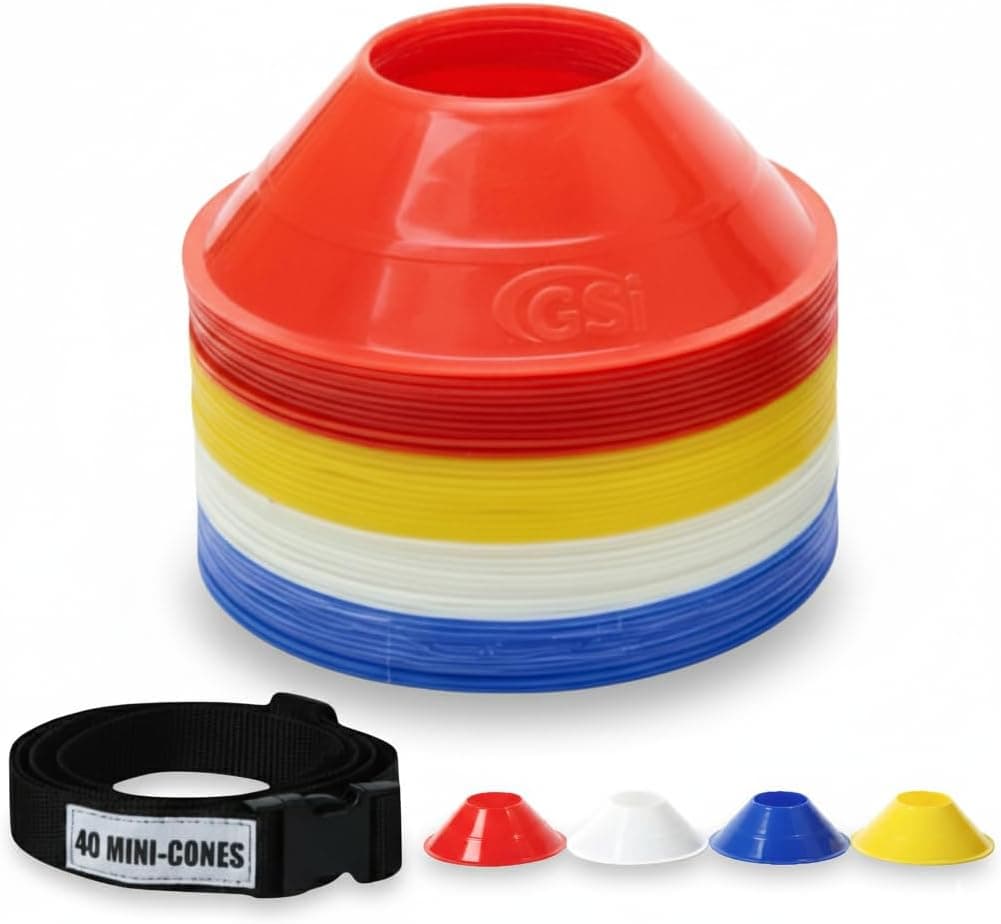
Disc Training Cones (Set of 40)
View on Amazon →As an Amazon Associate we earn from qualifying purchases, at no extra cost to you.