
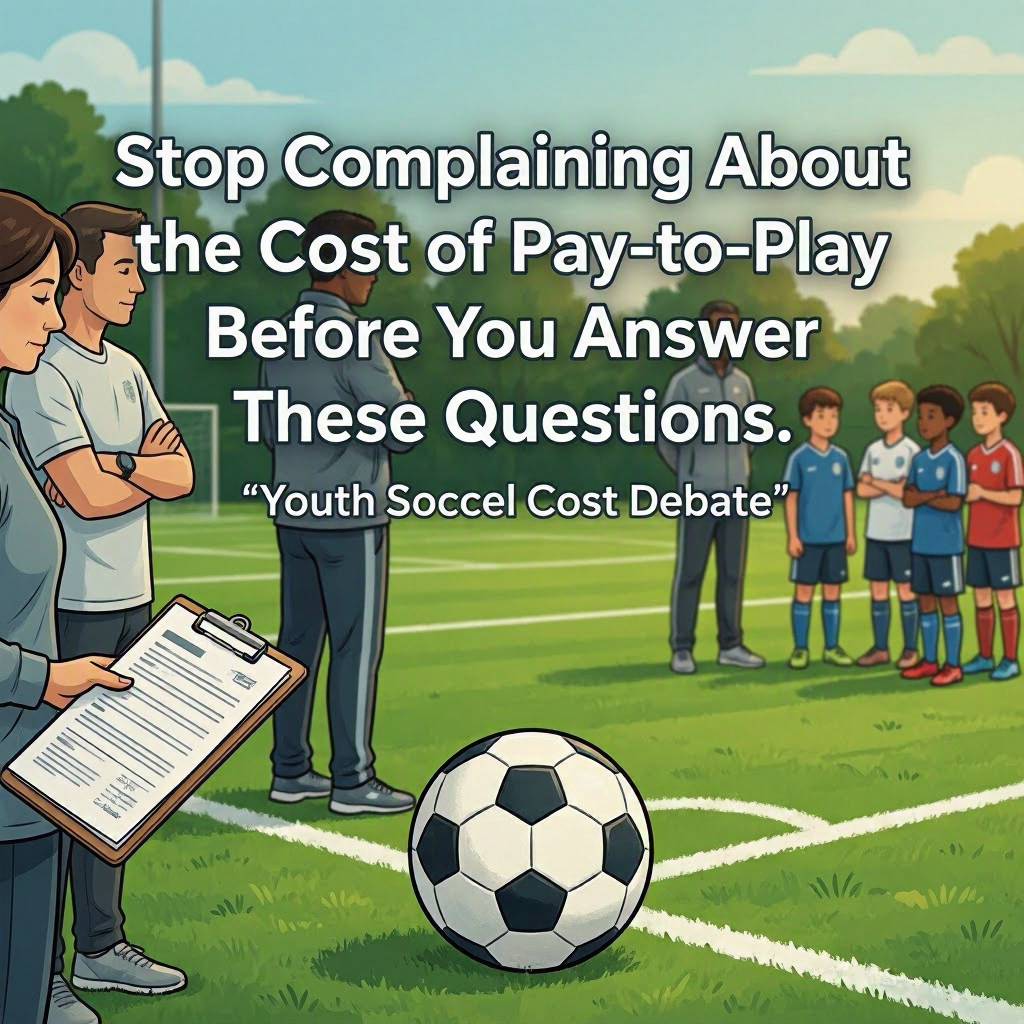
of running a soccer club?
Every few weeks, without fail, a version of the same conversation breaks out in our youth soccer communities online. Someone from another country — or someone who has spent time abroad — points to the cost of club soccer in the United States and asks, sometimes loudly: Why does it cost so much? In Germany it's $50 a year. In the UK they barely pay anything. What is going on?
I've had this conversation more times than I can count. And to be honest with you — I'm not here to dismiss it. The cost of youth soccer in America is a real conversation worth having.
But here's the thing: most people are having it wrong. They're skipping a step. A critical step.
Before anyone — parent, coach, influencer, or commentator — weighs in on pay-to-play, there's a discovery process we all need to go through first.
That's what this episode of The Inside Scoop is about. Not conclusions. Not a verdict.
A framework. A set of questions that, if answered honestly, will tell you everything you need to know about whether you're actually comparing apples to apples — or just apples to a country where someone donated the orchard.
“Every time I think this horse is dead, something happens to remind me it’s not only alive — there’s an army of Trojan horses running right behind it.”
Why This Keeps Coming Up
The argument is essentially this: soccer participation in the U.S. is expensive, and the rest of the world has figured out how to offer a comparable service at a fraction of the cost.
And it sounds compelling. You see a parent from Denmark paying $200 a year for their kid to play in a serious program. You look at your own invoice — maybe $2,000, maybe $4,000 — and the outrage is understandable.
But “something feels wrong” is not analysis. It’s a starting point. And too often, the conversation never moves past that starting point into the discovery phase where the real answers live.
The Discovery Questionnaire
If I could wave a magic wand before every pay-to-play debate, I’d require every participant to answer a specific set of questions about the programs they’re comparing. Not to win an argument. To understand what they’re actually comparing. Apply this to every program you reference — the one in the U.S. and every international program you cite as a benchmark.
You will notice the nine questions above say nothing about travel. That is deliberate. Travel is a discretionary expense that varies so widely it cannot be included in a baseline cost comparison without distorting the entire analysis. It needs to be evaluated separately.
 Here is a real example. My younger son's club fields two ECNL teams at his age group. One of them made the playoffs this season and will travel from North Carolina to San Diego for the game. The other team did not make the playoffs and will not make that trip. The cost difference between those two experiences is enormous — and it has nothing to do with what the program charges, the quality of the coaching, or the value of the training. It is a function of how far one group of players happened to advance in a tournament.
That one trip, if folded into a per-player cost comparison, would wildly skew any analysis. And yet it tells you nothing meaningful about the program's cost structure.
This is not to say travel costs are not a real financial burden — they absolutely are for many families. But discretionary expenses tied to competitive outcomes need their own framework, not a line item in the base comparison.
A Quick Way to Compare Travel Costs Across Programs
Look at travel miles per hour of soccer services. Take the total miles traveled in a season and divide by the total hours of training and games provided. This gives you a normalized travel intensity figure that makes different programs genuinely comparable — regardless of whether one team made a playoff run to the other side of the country.
The P&L Nobody Talks About
Here’s what those questions are actually doing: they’re reconstructing the cost basis of running a soccer program. They’re building a P&L — even a rough one — so you can evaluate what’s actually being compared.
Take my younger son’s current club as an example. They train three days a week, plus a physio day, plus weekend sessions when there’s no game. You’re looking at four to five days of soccer-related activity every week.
Multiple paid coaches. Specialty staff. You can’t compare that to a grassroots Saturday-morning program with a parent volunteer and then tell me the U.
S. is overcharging.
This Is Not a Conversation About Value
Before we get into the misconceptions, one thing needs to be said clearly: none of this is a conversation about value. Whether a program is worth what it costs is a completely separate question — and one that every family has to answer for themselves based on what their child is getting out of it.
We are not judging any program. We are not claiming anything is a money grab. We are not saying American youth soccer is bad, corrupt, or overpriced. We are doing one thing: establishing the cost basis so the comparison is honest.
That distinction matters. The moment this conversation gets framed as an attack on clubs, coaches, or the people who run programs — it stops being useful. There are thousands of people across the country who pour enormous time, energy, and expertise into running youth soccer programs at every level.
Most of them are not getting rich. Most of them are doing it because they love the game and believe in what they're building. Nothing in this framework is directed at them.
The nine questions are not designed to tell you that American youth soccer is overpriced or that the programs aren't worth the money. Some of them are extraordinary value. Some of them are not. That judgment requires a different conversation entirely.
What the questions are designed to do is much simpler: establish the cost basis. Before you can say one program is more expensive than another, you have to know what each program is actually spending money on. That's it. You are building the denominator before you divide. You are making sure that when you compare two numbers, those numbers are actually measuring the same thing.
Once the cost basis is established, the value conversation becomes much more honest. You might find that a program charging $4,000 a year is genuinely expensive relative to what it provides. You might find that it's exceptional value given the coaching staff, training hours, and facilities involved. Either conclusion is valid — but neither is reachable until you have done the work of understanding what the money is actually paying for.
The Three Biggest Misconceptions
For-Profit vs. Non-Profit: What It Actually Means
Before we go further, there is a label that gets thrown around constantly in these conversations that almost always misleads more than it clarifies: non-profit.
Here is what it actually means. A non-profit organization — specifically a 501(c)(3) under U.S.
tax law — cannot distribute financial surplus to private owners or shareholders. Any money left over after expenses has to go back into the organization's stated mission. That is it.
That is the legal distinction.
Here is what it does not mean: cheap. Low-cost. Community-minded. Volunteer-run. Accessible to everyone.
In practice, most youth soccer clubs in the United States — including many of the most expensive ones — are legally organized as non-profits. That surprises a lot of parents. The 501(c)(3) designation is often chosen for practical reasons: tax advantages, grant eligibility, donor appeal. It says nothing meaningful about how the organization is run or what it charges families.
This is not an ethical judgment. Both models are legitimate. A well-run for-profit club and a well-run non-profit club can provide nearly identical programs at nearly identical price points.
A poorly-run version of either can be expensive, inaccessible, and unaccountable. Both have a place in the ecosystem depending on who is running them and what community they are serving.
The legal status is not the variable that matters. What matters — and this goes directly back to the nine questions — is what the organization is actually spending money on, how efficiently it operates, and what it delivers in return. “Is it a non-profit?” is not the analysis. It is a distraction from it.
A Real Conversation — And Where It Went Off Track
Here is what this debate looks like when it plays out in the real world. This is a real exchange, shared publicly, that captures exactly the pattern this article is trying to interrupt.
“The problem is real and, as a board member of a competitive community club, I can tell you that fees at surrounding clubs are often more than double ours. Some have better facilities; however they are also for-profit entities — their allegiance is to their financial stakeholders — not the kids in their programs. The questions are valid — however the value proposition for kids playing in the US is often not.”
“If we were to compare the cost basis of the surrounding clubs vs. yours using these questions — what are you thinking we would discover? Coach pay? Training hours?”
“The purpose of this conversation is to get a better understanding of the cost structure. There are a few questions that need to be understood before any real conclusions can be made. For example, we don't want to mix volunteer coaching with paid coaching — we need to compare those situations separately.”
Look at what happened in the first message. A knowledgeable person — a board member, someone with genuine inside access to how a club is run — went straight from “their fees are double ours” to “for-profit entities whose allegiance is to financial stakeholders, not kids.”
That leap skipped every question on the list. It skipped coach pay. It skipped training frequency. It skipped facility costs. It went directly to a moral conclusion about where the other organization's loyalties lie — based entirely on legal structure.
And the board member's club may well be the better value. That is entirely possible. But we do not know that yet, because the discovery has not been done. “Their fees are higher and they are for-profit” is not the analysis. It is the starting point for one.
This is not a criticism of the person in that exchange. It is an illustration of how natural this pattern is. The for-profit label is a shortcut that feels like analysis. The nine questions are what actual analysis looks like.
A Word on Non-Profit Fundraising
There are some genuinely outstanding organizations across the country that do a wonderful job of raising money and offering soccer programs at little or no cost to families. These programs are real, they matter, and the people running them deserve enormous credit. If your child is in one of them, that is a great thing.
But — and this is important — a fundraising-supported program is a fundamentally different type of setup. It operates on a different cost model, depends on a different revenue base, and serves a different segment of the market than a fee-based club. Comparing the two on price is the same category error as comparing any other free or subsidized service to its market-rate equivalent.
The deeper issue is scalability. A well-run non-profit that raises $200,000 a year through community donations, corporate sponsors, and events can offer an excellent program to a limited number of players in a specific geography. That model does not scale.
You cannot replicate it in every zip code in the country any more than you can replicate the local restaurant that gives away free meals on Tuesdays by mandating that every restaurant do the same. The fundraising capacity, the donor relationships, the community infrastructure — those take decades to build, and they exist in some places and not others for reasons that have nothing to do with the willingness of clubs to offer lower prices.
So yes — celebrate those organizations. Support them where they exist. And recognize that they are a different animal from the fee-based club system, not a scalable blueprint for it.
Most importantly: pointing to a fundraising-supported program as evidence that pay-to-play clubs are overcharging is not a fair comparison. A club that raises $200,000 in donations and charges families nothing is not exposing a price-gouging problem in clubs that charge fees. It is operating in a completely different funding model. Using one to criticize the other confuses the cost basis — which is exactly what the nine questions are designed to prevent.
Where Other Countries Really Are Doing It Better
The discovery questions are designed to cut through bad comparisons — not to claim that every other country has nothing to teach us. There are real, meaningful structural differences that genuinely contribute to lower costs and broader access in many markets. Here are the ones worth taking seriously.
What the Discovery Phase Actually Reveals
Here’s what you will find in almost every meaningful comparison once you do the discovery work: the clubs you’re holding up as cheap alternatives are operating on a genuinely different cost structure — owned facilities, volunteer labor built over decades, different training frequency, or some combination. That’s not a knock on those programs. Some of them are excellent. But they are not the same product.
“Your ECNL team playing classic soccer doesn’t change the level of the players. The kids haven’t changed in one day.”
So What’s the Actual Solution?
The cost of youth soccer in America is too high for too many families. That’s real. It is pricing out talent, limiting access, and creating a system where financial resources are too often confused with athletic potential. But the solutions have to be grounded in what the discovery questions reveal — not in fantasies about replicating another country’s model wholesale.
An Open, Transparent Competitive Pyramid
One of the biggest structural issues is the absence of a clear, open pyramid that allows motivated volunteers and smaller organizations to enter competitive play. Creating accessible pathways for that profile of person could bring costs down and expand access meaningfully.
School-Club Partnerships Before Middle School
There’s a massive, underutilized asset in almost every American community: the school system. Clubs that partner with schools — sharing coaching resources, using school fields, building a pipeline — could dramatically reduce the per-player cost basis while still delivering quality development.
Rec-Select Hybrid Models
The all-or-nothing choice between elite travel club and recreational Saturday soccer doesn’t serve most families. Hybrid programs that give players real development and some competitive exposure at an accessible price point are already being built around the country. They need to be normalized and scaled.
“Once you answer those questions — then we can talk. Then we can talk about solidarity payments, government subsidies, academies. But we start with the P&L.”
The Demand Problem Nobody Wants to Talk About
While the U.S. has many genuine structural issues — and the six points above are real — any honest conversation about solutions has to account for something that rarely gets acknowledged: there is a cultural demand for a paid, premium youth soccer service in America that parents in most other countries simply do not expect. That demand distorts the marketplace in ways that no structural reform can fully fix on its own.
Do parents openly say they want to travel from North Carolina to San Diego for a youth soccer playoff? Of course not. Nobody sits down and says:
“I want to spend $3,000 on a single trip for my twelve-year-old.”
But they do want what they believe is best for their child. They want the best competition. The best exposure.
The best chance at whatever they think the next level looks like. And in a marketplace without a unified structure or regulated standards, “best” ends up being defined by whoever can create the most compelling story about elite development — which, in practice, often means more travel, bigger tournaments, and higher fees.
The supply side of this market responds to that demand rationally. Even if one club decided tomorrow to cap travel, lower fees, and opt out of the arms race, several others would immediately fill the gap. The parents who want the premium experience — even if they resent what it costs — would find another program willing to provide it.
That is not a moral failing. It is how markets work when demand is inelastic and supply is fragmented.
Any solution that ignores the demand side — that treats this purely as a structural problem to be fixed by policy — will fall short. You have to change what parents believe is possible and what they are willing to accept for their children. That is a harder problem than building a pyramid. But it is the real one.
Gear we use for this
The kit our own players train with at home.

Adidas MLS Training Soccer Ball
View on Amazon →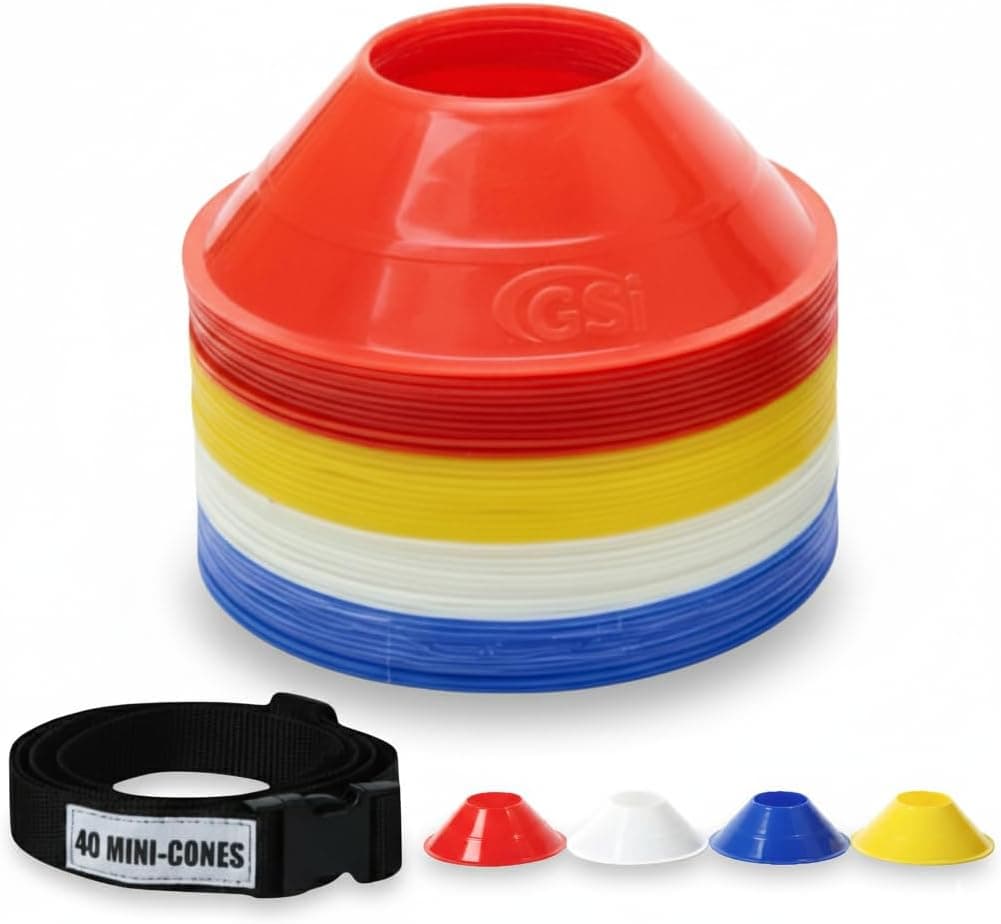
Disc Training Cones (Set of 40)
View on Amazon →
Soccer Rebounder
View on Amazon →See everything we recommendAs an Amazon Associate we earn from qualifying purchases, at no extra cost to you.
Pay to PlayYouth SoccerClub SoccerInside Scoop PodcastPlayer DevelopmentSoccer Parents
Gear we use for this
The kit our own players train with at home.
Adidas MLS Training Soccer Ball
View on Amazon →Disc Training Cones (Set of 40)
View on Amazon →Soccer Rebounder
View on Amazon →As an Amazon Associate we earn from qualifying purchases, at no extra cost to you.